Paul Tuns, Review
I … Do? Why Marriage Still Matters
by Andrea Mrozek and Peter Jon Mitchell (Cascade Books, 115 pages, $30 paperback)
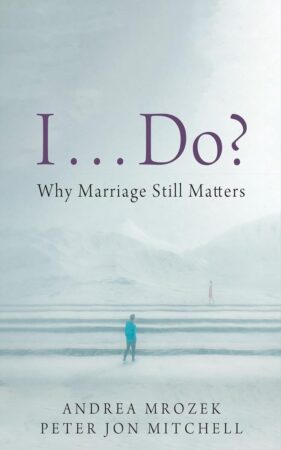 Andrea Mrozek and Peter Jon Mitchell are with the Canadian Christian think tank Cardus and their recent book I … Do? is an important and timely little tract on the why marriage matters – or more accurately, why it is beneficial — to both individuals and society.
The authors highlight that fewer people are getting married and many who do get married are waiting until later to do so. While acknowledging that marriage is not for everybody, these two facts, eschewing and delaying marriage, are problems for many men and women, as well as the broader society. In the second chapter, “The Marriage Advantage,” the authors point to copious research that proves “the centrality of family formation for our well-being in community, in health, in children’s outcomes, in wealth, and in general well-being.” As Mrozek and Mitchell argue, “public discussion should address the centrality of good marriages for the good life.”
With the “key caveat” that when the authors (and social science) talk about marriage being beneficial, they are talking about “healthy marriages,” they note that marriage shapes men and women in ways that benefit themselves, their children, and the community.
Married men are “happier, earn more money, and have better economic outcomes” than their unmarried peers, with married men more “attached to the labour force.” Research indicates that fathers married to their children’s mothers are better fathers. For men especially, the “success sequence” of completing their education, getting married, and having children, in that order, is the best way to avoid poverty.
The authors also recognize marriage is good for women, even if the case for such a claim is “slightly more complicated to make” considering today’s fraught ideological view that marriage benefits men “but enslaves women.” Still, for women who have children, marriage remains the best way to avoid poverty and that “women who become mothers need care and protection themselves in order to care and protect their babies.” Marriage is far superior in providing those benefits than any other arrangement. Furthermore, despite headlines that unmarried women have it better than their married peers, evidence suggests that marriage and parenthood (preferably combined) provide the “biggest happiness dividends,” in the words of Brad Wilcox and Wendy Wang.
For both individuals who want children and the society that benefits have higher fertility rates, marriage is hugely advantageous, with the authors pointing to recent research that shows
“one reason women who want children aren’t having them is the lack of suitable partners.” They note that declining fertility rates in the West are often accompanied by declining marriage rates (and declining church attendance). With the age of first marriage occurring later and later, the number of years in which couples are likely to have children shrinks, reducing fertility rates for both families and nations.
Pro-lifers should be concerned about the decline of marriage because figures from the Centers for Disease Control in the United States show that, in the words of Pew Research, the “overwhelming majority of abortions occur among unmarried women” (87 per cent). There is no comparable Canadian data. Mrozek and Mitchell say the correlation between pregnancy and being unmarried makes sense because “married couples are more likely to have the economic means and social and family support to navigate unplanned pregnancy.”
Marriage is good for couples, with married couples experiencing better health and financial outcomes, and live longer than their unmarried peers (for reasons tied to having an attentive partner).
Marriage is good for society because it builds up a community of adults and children with the social and emotional support to flourish. Healthy and stable families tend to produce healthy and stable communities.
Perhaps most importantly, marriage is good for children because the social science “clearly demonstrates family structure matters for children” (in the words of Child Trends) as they have better educational outcomes, fewer emotional and behavioral problems, better health outcomes, are less likely to attempt suicide or abuse drugs, and are less likely to experience poverty. Mrozek and Mitchell quote two sociologists, Sara McLanahan and Gary Sandefeur, who say that “if we were asked to design a system for making sure that children’s basic needs were met, we would probably come up with something quite similar to the two-parent ideal.”
Considering that there seems to be mostly upside, why are marriage rates declining? That is a complicated and multifaceted question. It is likely that modern liberalism, with its focus on individual rights and the consequent “move away from family as the central organizing unit of society” has done great harm to this foundational building block of society.
Another is that there has been a cultural shift from marriage as a “cornerstone” of our lives to being a “capstone.” That is, rather than getting married and then figuring out most of adult life, from having children, building a career, and creating a home – the cornerstone view of marriage – many young adults view marriage as something to be pursued only once they are well set in their careers and have the financial stability to buy a home and have a family – the capstone view of marriage. Marriage used to be the beginning of grown-up life, but that is no longer true for most adults.
The authors are also critical of the “soulmate” view of marriage as “too thin and impoverished to sustain a beautiful vision for the institution” of marriage. The soulmate marriage, in which each partner “completes” the other, is essentially hyper-liberalism invading marriage, that the institution rather than being about the couple is instead about self-actualization, an act that prioritizes the individual over the pair of husband and wife. (The authors detour into same-sex “marriage” and note that changing the definition of marriage invariably changes what marriage is, perhaps not for the better.)
The authors argue that for any number of reasons, policymakers do not privilege family, and sometimes even denigrate it. Sometimes this is to appear non-judgmental, sometimes it is animus to the institution of marriage (based in radical feminism or Marxism), sometimes it is the mistaken belief that the state has no business favouring one arrangement over another. Mrozek and Mitchell point out that “relationship choices are never confined to the private domain” and considering that marriage provides the basis for human flourishing, or at least increases the odds of that occurring, the state should be interested in promoting marriage.
Marriage, say the authors, “can no longer take marriage for granted.” Public policy debate and our own conversations need to better recognize the benefits of marriage. It is the admitted hope of Mrozek and Mitchell that their book would contribute to those discussions, as it should.
Paul Tuns is the editor of The Interim.