The Meese Revolution: The Making of a Constitutional Moment
Steven Gow Calabresi and Gary Lawson
(Encounter, $52, 468 pages)
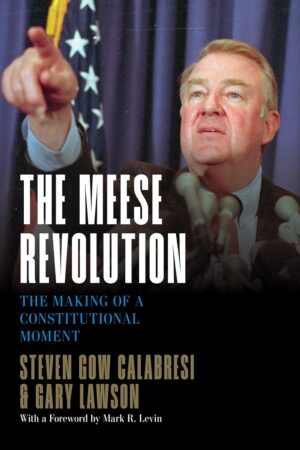 In 1985, Ronald Reagan’s Attorney General Edwin Meese III addressed the annual meeting of the American Bar Association when he said that under his leadership the Department of Justice would “resurrect the original meaning of the constitutional provisions and statutes as the only reliable guide for judgement.” The conservative legal doctrine called originalism had already been conceived, but on that day it was birthed into mainstream politics. In a remarkable combination of memoir and scholarship, Steven Gow Calabresi and Gary Lawson – two co-founders of the Federalist Society that has supported several generations of conservative lawyers, legal scholars, and judges — explore Meese’s central role in making originalism the overriding principle of Republican judicial politics and the conservative movement’s legal philosophy. Originalism was not merely a reaction against judicial activism, a (belated) call for judicial restraint; it paid respect to the structures of governance created by the Constitution and the letter of the laws passed by legislatures; it sought not intent but meaning from these original texts. Far from judicial restraint, Meese encouraged an active judiciary that would return America’s Constitutional order. The authors are careful not to conflate “conservative judicial philosophy” with “originalist judicial philosophy,” with the former seeking particular policy outcomes while the latter “describes an approach toward ascertaining the meaning of the Constitution’s text.” Sometimes the two result in the same outcome, but not always.
The Meese Revolution: The Making of a Constitutional Moment is an important contribution to the history of the originalist legal movement by focusing on one man’s influence, Meese’s, who would recommend to Reagan appointing Robert Bork and Antonin Scalia to the Supreme Court (Bork was rejected by the U.S. Senate) and other worthy judges to the lower courts. Influenced by originalist thought-leaders such as Bork, Meese set up “an academy in exile” in the Department of Justice to support originalist thinkers, who in turn provided guidance to the administration. Meese was a political giant who is practically unknown today to young conservatives, but his influence on the courts and the politics of the judiciary is undeniable. The authors state that Meese “both inspired and facilitated younger generations of scholars, as well as younger generations of activists in and out of government,” whose fruits are evident in decisions like the Supreme Court’s 2022 decision in Dobbs overturning the egregious Roe v. Wade decision of 1973. For that Meese is owed a debt of gratitude, partially paid by this overdue biography.