UN agencies use AI to spy on youth
UN agencies are targeting adolescents around the world—India, Eastern and Southern Africa, the Philippines—by spying on them for their attitudes towards contraception, abortion access, and sexual identity. The agencies target youth with information to change their traditional, family views on these controversial issues. UNFPA (United Nations Fund for Population Activities) works in more than 150 countries to “ensure sexual and reproductive rights and choices for all, especially women and young people.” It often hides its main objective by insisting that it is only concerned with improving maternal health. From 2022 to 2023 it used an AI-based Early Warning System in Zambia, Rwanda and Namibia to obtain “real-time information” on “dialogue (and) social media behavior” of adolescents on sexual and reproductive health. It then leveraged AI to create a response to “the root causes and/or prevent further escalation of the early signs” against sexual and reproductive issues.” In other words, it was using AI to spy on young people to find out where the opposition to contraception, abortion and sexual identity was, so the UN agency workers could work to change the attitudes among young people on these sexual topics. UNFPA has invested in AI bots around the world in order to answer adolescents’ questions about sexuality with the purpose of ‘guiding’ them toward ‘safe’ sex and contraception. The UN Secretary-General recommends that member states (like Canada) “engage with disinformation fact-checkers,” using ‘take-down’ procedures to deceive those who believe in traditional, family values where sex is for marriage and family. Families must remain vigilant and protect their children from those who do not have their interests at heart.
The Sacred Heart of Jesus: the antidote to ‘Pride’
In the June 9, 2025 on podcast Catholic Unscripted, Gavin Ashenden, former Anglican bishop converted to Catholicism gave a talk entitled, “This June, we challenge ‘Pride’ with the Sacred Heart.” Following are comments from his presentation:
“The ‘Pride’ flag and other ‘Pride’ things look like they are about compassion and tolerance. They are not. They are about sexual aberrations, power and coercion. They are about replacing what is good and true (God) with what is ugly and deceptive (Satan). They are about coercing the citizenry to accept a perverted ideology.
“‘Pride’ stands with the ‘new world order,’ an international totalitarianism which aims to destroy the world as we know it and replace the Christian moral order by identity politics. Certain categories of humans will be excluded: the unborn, the vulnerable elderly and disabled, and troubled teenagers who are being surgically altered and damaged for life.
“The ‘Pride’ flag becomes as multi-layered in its ambitions as it is multi-coloured. It signifies social exclusion for those who refuse to conform. It is, in fact, the flag of the enemy who seeks, first by subterfuge, but now by force, to obliterate all things Christian. The iron fist behind the rainbow glove has been unmasked as cultural Marxism, a new iteration of the totalitarian instinct that crushed the churches that lay behind the Iron Curtain.
“The roots of Marxism can be traced back to the French Revolution. It was at that time that Sister Margaret Mary Alacoque, a French nun, experienced visions of Jesus and was entrusted with promoting devotion to the Sacred Heart. The Revolution and the Sacred Heart represented two wholly different things: one to do with pride and one to do with love and humility. It was devotion to the Sacred Heart of Jesus that rescued our ancestors from the unforgiving grasp of paganism, and converted the West with the love of Jesus. Pope Leo XIII consecrated the entire world to the Sacred Heart in 1899 and it is the Sacred Heart of Jesus that will rescue us today from the totalitarian utopia that surrounds us. It is traditionally celebrated during the month of June.”
Pope Leo XIV and Rerum Novarum
Rerum Novarum, the foundational encyclical on Catholic social teaching was issued by Pope Leo XIII in 1891. It addressed the conditions of the working class in the wake of the industrial revolution—poverty, family break-down, oppression by the merchants of labour, infant mortality, unsafe working conditions, unhygienic living conditions. In his encyclical, Pope Leo XIII wrote that “a remedy must be found quickly for the misery and wretchedness pressing so unjustly on the majority of the working class.” He emphasized a “need for reforms to protect the dignity of the working class while maintaining a relationship with capital and the existence of private property.” The encyclical reminds the wealthy owner of industry that he must “respect in every man his dignity as a person ennobled by Christian character,’ and to “never misuse men as though they were things in the pursuit of gain or to value them solely for their physical powers.” Pope Leo XIV referred to Rerum Novarum in an address to the Vatican Diplomatic Corp on May 16: “it is the responsibility of government leaders to work to build harmonious and peaceful civil societies … by investing in the family, founded upon the stable union between a man and woman, a ‘small but genuine society’ (a phrase borrowed from Rerum Novarum) … ensuring respect for the dignity of every person.” Elsewhere, (the new) Pope Leo indicated that he will use the encyclical, together with the full body of the Church’s social teaching, “to navigate the developments of artificial intelligence.”
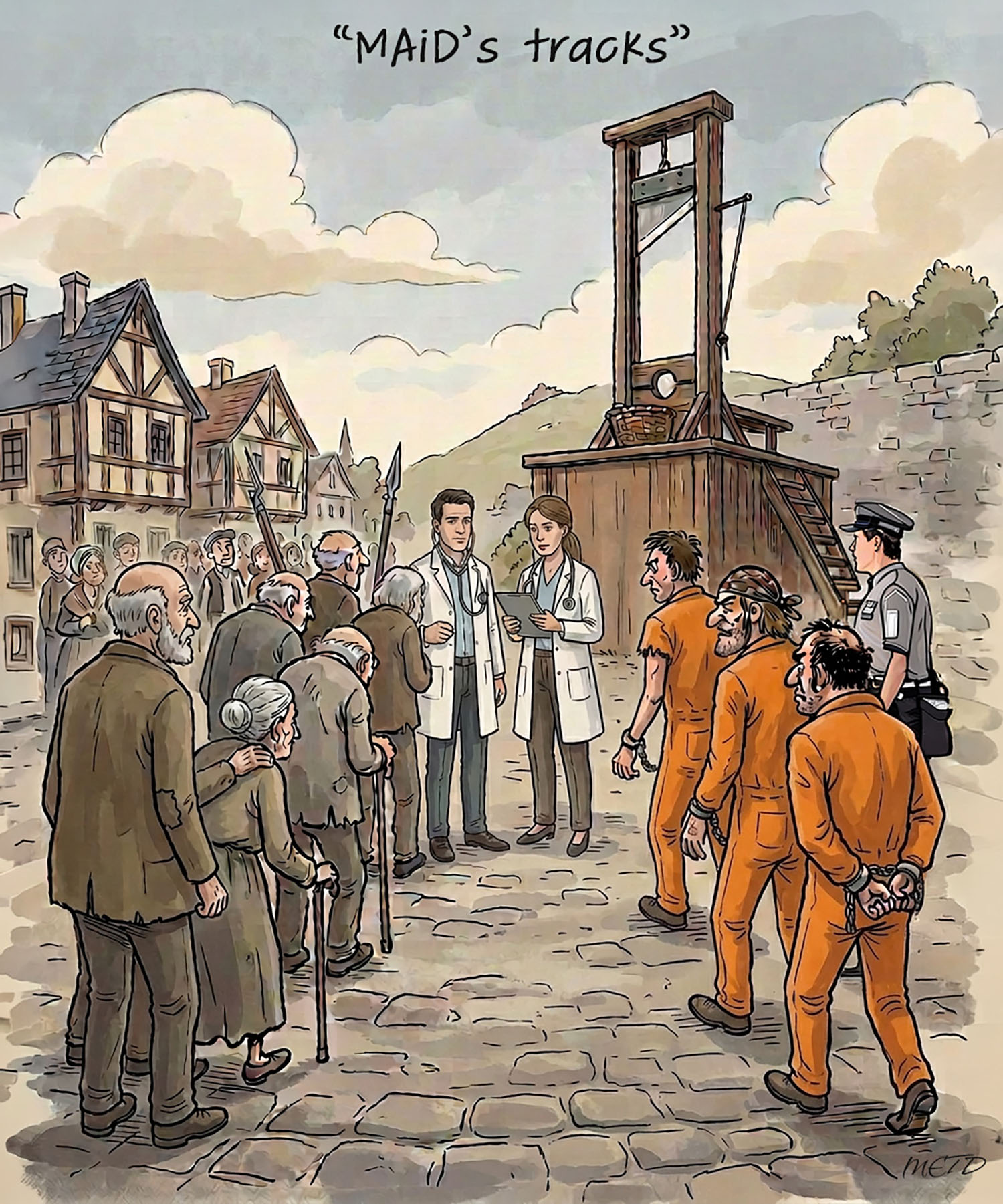
UN demands Canada get rid of Track 2 MAiD
Patty Hajdu is the minister of Jobs and Families and responsible for persons with disabilities. In June, Canada was called to a hearing of the U.N. Rights of Persons with Disabilities to explain why it had not repealed its 2021 law that expanded eligibility for assisted dying to those, including the disabled, whose deaths were not reasonably foreseeable. Hajdu did not answer the UN’s concerns but instead babbled on about her commitment to make “relationships in this space (as a minister) and making sure that I have really strong relationships with the community, which I think is really important to be a good minister.” Where is her “relationship” with the disabled community that is offered death (MAiD) “without providing safeguards that guarantee the provision of support,” indicated by the U.N. report? A Liberal government spokesperson wrote in response to the UN: “MAiD is a deeply personal choice. We will make sure that the rights of persons with disabilities are upheld and protected.” But will they?
A recent article by Barbara Kay in the National Post described the plight of Roger Foley who has been fighting to live in his apartment with appropriate self-directed care, a program devised and then discarded by the Ontario government. Instead, he remains in a London, Ontario hospital where he doesn’t require the acute care that the hospital offers him. He is not allowed to return to his apartment, and he rejects a transfer to a long-term care facility. Inclusion Canada has filed a Charter of Rights challenge against what is called Track 2 MAiD, which “allows people with disabilities to access state-funded death in circumstances where they cannot access state-funded support they need to make their suffering tolerable.” That is what the U.N. is demanding of Canada: Get rid of Track 2 MAiD.
A reunion between a preemie and an intern Protecting America’s elderly
It was a snowy night in January 1968 in Saint John, N.B. The doctor in residence had to go to another hospital to deliver a baby, and left intern Donald Craig in charge of a six-month pregnant mom ready deliver with the expectation that the baby would be stillborn. Craig had only assisted at births, so he went to refresh procedures. Then the nurse told him that the baby was breech, so he returned to the books. Finally, the nurse took him to the delivery room, where the birth was in progress, He had to break the baby’s clavicle, but he managed to deliver the baby. He heard the baby crying, and then the mother started to cry: “Is that my baby crying?” It was indeed! The baby girl, later named Krista, weighed two pounds and was three months premature. The odds of surviving were poor. In the hospital, sleeping, was a pediatrician, newly hired, who was available to help. She arrived in pyjamas and housecoat, and asked Craig, “Did you deliver that by yourself?” before demanding, “Give me the baby.” Fifty-five years later, Dr. Donald Craig had retired from his medical practice. Along the way he had been president of the College of Physicians and Surgeons of New Brunswick and had founded the New Brunswick Medical Education Foundation. And so, in April when the foundation presented him with their Champion of Care Founder’s Award, it came along with a surprise: Krista Barezyk, the baby that he had delivered in 1968, would present him with the award. As Barezyk remarked, “If is hadn’t been for him, none of what I went through would have happened. I never would have fallen in love … I never would have married, had my three children, and been able to have grandchildren.”