
By Rick McGinnis
In the first decades of the 19th century, upstate New York became known as the “Burned Over District,” a hotbed of spiritual revival that gave birth to an explosion of religious sects and utopian communities. Usually evangelical and often millenarian in nature, these included the Shakers, the Mormons, the Millerites – who would in turn produce Seventh-day Adventists and Jehovah’s Witnesses – as well as the Oneida and Amana communities (the former a blueprint for the free love communes of the 1960s) and the Social Gospel movement.
The area – extending into the Ohio River valley and the lower American Midwest – was still very much part of the American frontier, which meant that mainstream Protestant congregations were underserved by trained clergy. This lead to lay people and zealots and the occasional huckster interpreting gospel according to their fundamentalist reading of scripture – a third wave of Protestant schism, since many of these sects came out of Baptist, Methodist and Congregationalist nonconformist churches.
Modern eyes, blind to context, would assume this was a conservative movement, but they’d be wrong. The Burned Over District and its religious fervor would inspire abolitionism and women’s suffrage as well as spiritualism, and early heroes of American progressive politics were often inspired or trained by the social and political movements unleashed by this religious awakening.
Coming so soon after the revolution that founded America, it’s hard to deny that this utopian religious fervor is baked into the character of the American project, much as Puritanism hard wired a sense of God-given mission and a tendency for harsh judgment into the colony long before nationhood. I can’t help but remember all of this while observing the apparent triumph of “wokeness” and identity politics, in western society in general and America in particular over the last couple of decades.
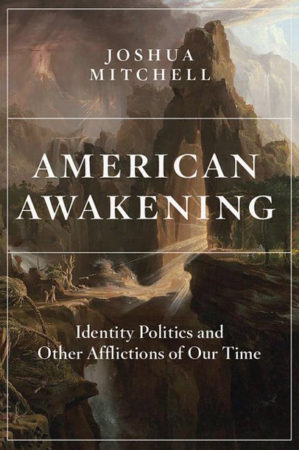
Joshua Mitchell, a professor of political theory at Georgetown University, also noticed it, and has explored the essentially evangelical nature and theological inspiration for deplatforming, cancel culture, social justice, hashtag activism, and virtue signalling in his densely-argued but excellent new book American Awakening: Identity Politics and Other Afflictions of Our Time.
As far as Mitchell can see, the conflict powering wokeness is transgressors versus the oppressed – that is, the identity group who historically benefitted from oppression and the group they oppressed, a relationship that implies a debt from the former to the latter that must be repaid to make society more equitable and satisfy our need for justice. It’s a relationship where the oppressed are innocent and pure in their victim status, while the transgressor carries a moral stain that they must expunge.
It’s an essentially religious concept in a post-Nietzschean world, where God – the ultimate arbiter of justice – is absent, and Christ, the “Divine scapegoat” as Mitchell calls him, is out of the picture, forcing the yoke of the debt on human beings unlucky enough to share the same ethnic identity as slaveholders, robber barons, sweatshop owners and segregationist sheriffs – straight white males, in essence.
“Identity politics recapitulates the early Protestant pronouncement about the stain that deforms the world,” Mitchell writes, “and indicts tradition … Identity politics inaugurates a kindred reformation by declaring that underneath the superficial world of payment lies debts that the well-balanced books of the world cannot fathom.”
The urbanized first world of today, with its intensely polarized politics and social media minefields, has come to resemble this Burned Over District, a home to intense zeal and fervent, pitiless theologies based on perfecting this world, here and now, no matter the social and personal costs. It’s a world of the clean and pure versus the dirty and stained – a place of sin and sinners, with the innovation that sin is not just inherited but inherent to anyone with the misfortune to be born within a combination of intersectional transgressor identities.
Right now the heterosexual, Caucasian male is the scapegoat, implicated in centuries of oppression even if he’s personally blameless, or descended from generations of powerless proletarians; Mitchell is at pains to detail that this new religion is both post-Christian and post-Nietzsche, but also post-Marxist. Sitting at the top of the transgressor class, he’s an easy and convenient target, with plenty of his kind willing to admit to their actual or implied sins, in the hope that their punishment will stop and move on to another sinner.
This can’t go on forever, and when we run out of targets the inquisition will move on to adjacent identity groups: straight white women, then heterosexual black men, straight black women, gay white men, white lesbians, and upward through Latinos, Asians and so on, with special attention paid to anyone who protests or denies the galloping logic of this hierarchy of the oppressed. No one is safe since this machinery needs to purify all of society to achieve its utopian goal of erasing the stain of what it considers unearned privilege – zeroing out the debt the transgressor owes to the oppressed.
Though most of its zealous adherents won’t recognize it, the familiar logic of woke social gospel adopted by mainstream Protestant churches eager to remain relevant must resonate with some clergy. (And to be fair, the top-down invocation of social justice has spread into the post-Benedict Catholic Church.)
But the woke gospel departs sharply from its Christian template in one crucial way.
As I write this, the news cycle has briefly lit up with the story of Alexi McCammond, the newly-appointed editor of Teen Vogue, forced to resign her position after decade-old anti-Asian and homophobic tweets written while she was a teenager surfaced. The African-American McCammond hadn’t even started her new job, and said in a (perhaps naively hopeful) statement that, “I look at my work and growth in the years since, and have redoubled my commitment to growing in the years to come as both a person and as a professional.”
I couldn’t help but recall the popular podcaster and comedian Joe Rogan, asking plaintively during one of his shows about cancel culture if there was any possibility for forgiveness in this relentless hunt for transgressions, youthful or otherwise, captured on the long timeline of social media. The short answer according to Mitchell is “no,” especially now that we’ve shifted personal morality from the religious to the political. “There is no forgiveness of transgression in the world of identity politics. Forgiveness discharges a debt. In the world identity politics constructs, political power accretes from debts that cannot be discharged. To forgive is therefore to lose hold on political power.”
Later in his book he states this even more starkly: “In identity politics, there is no exultation for the scapegoat, only humiliation; the transgressor lives forever on Good Friday, without hope of seeing Easter Sunday.”
The only antidote Mitchell proposes to woke social gospel is an old one – the “patient and unending labour” that comes from the “liberal politics of competence.” Citizens, acting out of enlightened self-interest understand that the path to real civic peace is engagement – looking outward, not inward or upward. That we’ll only break the cycle of unpayable debt by recognizing our common purpose and shared identity as citizens within nations.
We have to renounce the shortcuts that tempt us, like the outraged (and anonymous) tweet, complete with profanity and hashtags, that substitutes for action and provides a cover for future accusations of real or inherited guilt. In a COVID coda, Mitchell admits that lockdown and quarantine – self-isolation so evocative of Passover, where the Israelites locked their doors to escape death – has probably forced our inward isolation ever deeper.
The endgame of the woke gospel is bleak. After Western Civilization has been placed on the bonfire, the tribunal must move ever onward in search of sin and sinners, and eventually the whole post-Edenic human project will be indicted for its millennia of crimes against nature, that most innocent of victims. One motto of the environmental movement is that there are “too many of us,” and Mitchell observes that “because Western civilization destroyed the first innocence, it owes a debt to nature and to other civilizations that it cannot repay except by extinguishing itself.”
This road to madness is self-evident, and our only hope is that other cultures – uninterested in identity politics and immune to America’s zeal for purity, atonement and a perfect world here and now – will politely shake us out of our trance with mockery and ridicule.


