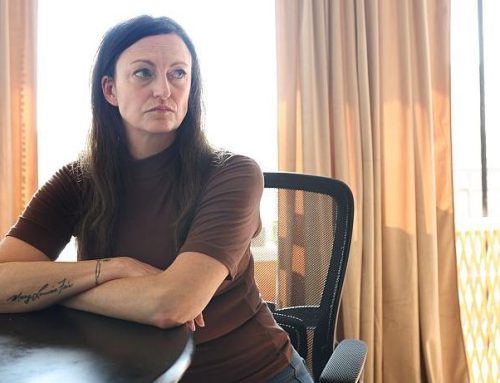
Helen Charlotte Hough, 60, divorced mother of four children and author of children’s and mystery books, was jailed for nine months after helping a friend to commit suicide.
Mrs. Hough admitted to the attempted murder of Anneta Harding, age 83, described as frail, deaf, nearly blind, arthritic and lonely. She put a plastic bag over Miss Harding’s head after a supposedly-lethal mixture of drugs and drink failed to work.
The prosecution had originally charged Mrs. Hough with murder but had dropped that charge when medical experts could not confirm positively that the plastic bag had caused Miss Harding’s death. She had already taken an overdose of sleeping pills, 10 times the therapeutic dose, which Mrs. Hough had obtained for her, and her tongue may have caused her to asphyxiate and die.
Mrs. Hough, a counselor for “Samaritans” – a “hot-line” for those thinking of committing suicide – had agreed to stay with Miss Harding while she died and had promised her that she would not be resuscitated.
Miss Harding was a member of the Voluntary Euthanasia Society (formerly called Exit) and used its booklet, “Guide to Self Deliverance,” to determine how best to attempt suicide. She attached a note to her chest which stated “I have decided to take my own life. This is a decision taken in a normal state of mind and is fully considered.”
Judge Tom Pigot Q.C. told Mrs. Hough that he was satisfied she was a caring, sympathetic and compassionate woman who acted out of the best Christian principles.
She broke the law
But, he added, “The law exists to protect the sanctity of life, even if that life is of a person in a come, on the verge of death. What you did was to accelerate death, which was probably inevitable in a short time. I have no desire to punish you, but I must bear I mind the need to deter others less altruistic than you who wish to accelerate death in different circumstances.”
Although Mrs. Hough appealed her nine-month sentence, the minimum allowable under the law, the Court of Appeal upheld the lower court decision. The Lord Chief Justice, Lord Lane, commented that it appeared to the three appeal judges that Mrs. Hough was “too ready to play an active part in the provision or using of the paraphernalia of death.” Emotion ran high in such cases, said Lord Lane, but the court’s job was to apply the law according to precedent and statute.
Barbara Smoker, chairman of the Voluntary Euthanasia Society said that Mrs. Hough was “forced to choose between immorality and illegality. She had promised she would not let the woman continue an intolerable life, but by fulfilling her promise, she broke the law. We cannot condone any flouting of the law, but we think the case underlines the need for the law to be changed.”
One British editorialist saw the matter in another light. Criticizing the defence counsel’s view that Helen Hough was compassionate, unselfish and merciful, the writer said “What had she actually done? She had bought sleeping pills for a blind old lady who said she wanted to kill herself. Then she had picked up a plastic bag and put it over the old lady’s head.
“God spare humanity from such ‘mercy.’ Such ‘compassion.’ Mrs. Hough was sentenced on Friday to just nine months in prison. Which means that she will be out in six, still believing, no doubt, that she should be pitied and admired for what she did.
“This evil, arrogant and ruthless woman should be locked up for a good deal longer. So that do-gooders like her may realize that not even a self-righteous busy-body has the right to take innocent human life.”