Paul Tuns, Review:
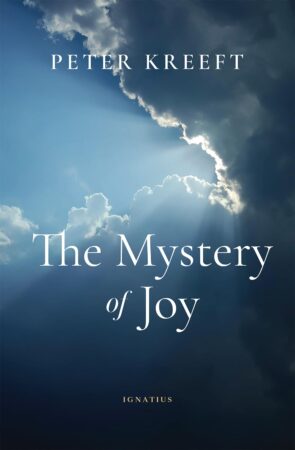
The Mystery of Joy
by Peter Kreeft (Ignatius, $18.95, 241 pages)
Version 1.0.0
Peter Kreeft’s latest book offers 95 pensées about joy, short, (two to four page) thoughts on what joy is, and isn’t. Joy, says Kreeft, “is to happiness what happiness is to pleasure: the next step up.” According to Kreeft, way up, up to heaven. He takes issue with Freud and his “pleasure principle” that mankind is born “innately longing for pleasure and hating pain,” which is so obvious, it is hardly worth noting. But it is also insufficient. We want, or should want, joy, which “is bigger than we are.” Happiness, Kreeft says, “is in us, but we are in joy.” We enter joy, joy does not enter us.
Kreeft gives the game away in his third pensée (chapter). Joy is the great comfort in the objective fact of Christ’s joy: “He is our joy.” One might argue that there is an element of circular reasoning here, and that’s the mystery. In the next 92 pensées, Kreeft is trying to convince us. Ultimately, his argument echoes St. Augustine. In Kreeft’s words: “Do you want to live in the world God willed for you or the one you desire for yourself?” That is the choice each individual must make. Joy is not a feeling, but a fact, a fact based on the action(s) of each person.
Echoing Aquinas – Kreeft notes in his introduction that he is a philosophy not a psychiatrist – “when the good is present, love takes the form of enjoying, joying-in, and affirming the present good.” Love and joy, he says, “are essentially acts of free wills, acts of choice,” although they may be “accompanied by feelings,” including pleasurable ones. But feelings are “not objective reality” or the basis for knowing the world. Joy is.
Quoting the most philosophical of baseball greats, Yogi Berra, Kreeft observes: “if the world were perfect, it wouldn’t be.” We would be miserable, left to obtain merely our own earthly desires. Seeking God with an open heart and open mind, doing His will, and acting in a way to eventually experience everlasting joy in heaven, is the source of joy not only in the next world, but this one. That is not to say that there will not be pain or suffering, and it is on the age-old question of why does God permit suffering in the world that The Mystery of Joy is a book that everyone should read in these troubling – sometimes chaotic, sometimes painful – times.
Essential to joy, is faith in God, that is, trust in God. “God will always give us what is best in the end, even though it seemingly deprives us of joy now.” “Doing hard things out of love for God and neighbour,” Kreeft says, “adds a kind of joy even within the act of suffering.” Doing so turns suffering into an act with purpose “instead of victimization.” Joy can never be surrounded by sorrow but with God our sorrow is surrounded by joy. Kreeft admits that when life is difficult, “the temptation naturally appears to doubt God’s existence.” Kreeft turns that doubt on its head and says that suffering only makes sense if there is an omniscient, omnibenevolent, and omnipotent God that gives purpose to our pains and sorrows. To abandon God, he says, is to abandon “our life preserver when our boat is sinking,” which would be “the most unreasonable thing we could possibly do.”
Without suffering, Kreeft says, “we would stagnate.” Or worse. We would have no way to heaven. All sin is essentially pride, saying “My will be done” instead of “Thy will be done.” Suffering is an antidote to pride, nudging us to seek God’s eternal comfort. Kreeft calls pride making peace with the Devil. “God allows evils in our lives only for the sake of greater goods or to avoid even greater evils,” says Kreeft, for God is all-loving, all-understanding, and all-powerful. Our sufferings can save us from the temptations of hell, from the stagnating lukewarm life of creature comforts.
Kreeft says in his chapter on “Heaven and Hell” that most people’s problems, their journey away from joy, begins with the mindset of “My will be done” not “Thy will be done.” Only with God can mankind experience true joy. When we play God by obeying “my will” rather than “His will,” it is “a sin against honesty and humility,” two virtues essential to joy. As early as his 14th pensée Kreeft says “the secret to joy is to love God and what God omnisciently, omnibenevolently, and omnipotently wills for us” by loving “our spiritual siblings, our ‘neighbours,’ as God loves them.”
The opposite of joy and love is war, and Kreeft calls abortion “the worst form of war” because it is the “war that comes closest to home … war within the family, war within the womb, war against our own sons and daughters, whom we poison or rip apart.” Abortion, Kreeft correctly identifies, is the most pressing justice issue of the day. If God is joy, and God is Truth, Beauty, and Goodness (which includes justice), is it any wonder that a society such as ours that kills hundreds of preborn babies a day is such a miserable one? Contrarily, the “greatest art, the greatest work of creation, that we can possibly accomplish is procreation, in which we supply the body for which God creates a new eternal soul.”