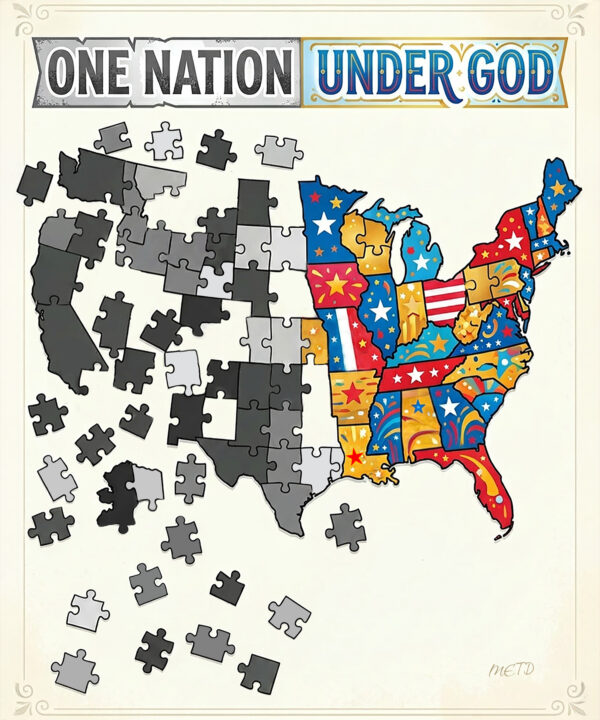
 This July marks the 250th anniversary of the United States Declaration of Independence. Although it would take the 13 colonies that many years to win the Revolutionary War and then establish themselves as states within a constitutional framework, that foundation—and all else that has flowed from it in the ensuing quarter millennium—springs from this document. While the vast majority of the Declaration, comprising a litany of complaints about the English monarch, is now of interest only to historians and antiquarians, its famous, bold, and inspiring assertions remain stirring to us today: “We hold these truths to be self-evident, that all men are created equal, that they are endowed by their Creator with certain unalienable Rights, that among these are Life, Liberty and the pursuit of Happiness.” However, as First Things editor R.R. Reno has recently noted, these ringing words depend on a reality acknowledged in the opening paragraph which precedes it—namely, that the colonists constitute “one people.” As Reno puts it: “the liberal principles that inform the Declaration’s second paragraph are empty without the presumptive unity and coherence of the nation.” And it offers no resources, Reno goes on to note, “for sustaining, much less restoring, national unity and civic coherence” once it has been lost.
It cannot be controversial to assert that, on this 250th anniversary, America hardly seems to be “one nation.” Even without broaching the topic of ICE raids, migrants, and the legal status of the people living within its borders, the divisions in modern-day America are painfully obvious. The country’s deep political rifts have entered common parlance with the terms “red states” and “blue states;” even though politics may not define the details of every daily interaction in these places , the prevalence of familiar touchstones—American flags and Bible verses in the one and pride flags and preferred pronouns in the other—serve as reminders of both the scale and the depth of the chasm that separates the countrymen of America from each other. Indeed, the adjective, “united” in “United States” now rings with a certain irony, as does the country’s traditional Latin motto: “E Pluribus Unum” or “out of many, one.”
Rather than retracing the current divide to the first emergence of these political fault lines, this year’s anniversary lets us pose a pressing question at the very origin of the so-called “American Experiment:” on what basis could those who endorsed the Declaration of Independence consider themselves to be “one nation” in the first place? A ready-made answer which both right-wing and left-wing extremists might offer would identify the source of this unity in the shared ethnic stock of the Declaration’s signers. Such an obvious and superficial response is one which history, regrettably, makes plausible given the subsequent sad history of race-based slavery that took root in that country. Nevertheless, even at the moment of America’s founding, this answer is insufficient; the 13 colonies would, soon enough, be roiled by debates over the “peculiar institution” of slavery, and this evil would only be exorcised a century later through the tragedy and tumult of the Civil War.
Moreover, the pilgrims who first came to America over a century before the Revolutionary War did so partly because their own already ethnically homogenous homeland had been plagued by civil war and strife concerning the free practice of religion. The first pilgrims were seeking, above all else, a favorable climate in which they could practice their religion without fear of undue encroachment by political forces. In other words, their religious identity was at least as important as their “English” cultural inheritance—one which Americans retain as the name of their tongue, in addition to the Imperial system of miles and gallons which they still use today.
Thus, the Declaration of Independence’s famous affirmation of self-evident rights endowed by a Creator—which is not wrongly taken as an expression of Enlightenment universalism—rests silently on a compact of national and universalist values, of cultural and creedal identities which subtend the subsequent expressions found in the Declaration. The shared and cherished traditions of English common culture and various forms of the Christian faith are what enable the articulation of the emerging American identity. The natural bonds of family, memory, and heritage and the supernatural virtue of Faith which places the drama of human life against the horizon of God’s Providential plan are the wellsprings that nourished the architects of America who, as the inheritors of rights enjoyed by their fathers and ordained by God, appealed to both for the justice of their cause.
In other words, those who signed the Declaration of Independence felt that they had both a past and a future: the one was their patrimony, the other would be bestowed by the Divine as a blessing which they strove to deserve. This is why an undue focus on ethnic or cultural composition of either the founders or of modern-day America misses the point: what makes one people out of a plurality of persons is membership, by blood or adopted, in a temporal family, and the recognition of a filial condition within the supernatural family of which God is the head.
This is why only one metric is needed to measure the health of any civilization: its birthrate. Extant multi-ethnic societies like America are now struggling just as much as homogenous ones like South Korea or Japan because, in both cases, religious faith is waning. The model that St. Paul gave the Galatians (3:28)—“There is neither Jew nor Greek, there is neither slave nor free, there is neither male nor female, for you are all one in Christ Jesus”—remains possible for us in the West today; the only question is whether or not we will adopt this model, and enter into the continuum of Christian civilization which itself retained and purified the traditions of the Classical world.
At this juncture, we hold two truths to be self-evident: that the hour is late; but even so, with the acceptance of God’s assistance, the hour is not too late. There is still time for America in particular—and the West more generally—to become one people, to put aside division and strive, and to thrive in the blessings that God is, even now, longing to shower on the nations that turn to him with humble and contrite hearts. The 250th birthday of the United States is the perfect occasion for such contrition. If America sincerely and wholeheartedly turns away from the unspeakable evil of abortion, its future will be secure. We hope and pray that it does.