Paul Tuns:
On Oct. 7, the Liberals and Bloc Quebecois voted down a private member’s bill that would have permanently excluded mental illness as the sole eligibility for euthanasia in Canada just hours after the government announced it would introduce its own bill indefinitely delaying the expansion while at the same time permitting advance directives for people with degenerative illnesses that compromise their ability to later consent to so-called Medical Assistance in Dying.
In 2021, Parliament passed an expansion of the 2016 euthanasia law permitting non-terminally ill patients to access MAiD for “irremediable” but non life-threatening conditions, but delayed implementation for mental illness as the sole underlying condition for two years. It has since been postponed twice due to political pressure and opposition from mental health experts that it is impossible to determine if a mental illness is irremediable and the difficulty in making a distinction between suicidality and a request for euthanasia.
C-218
In response to the outcry against the mental illness qualification for euthanasia, Tamara Jansen (Cloverdale-Langley City) tabled C-218, The Right to Recover Act, which if passed would have permanently removed mental illness as an eligibility requirement for MAiD. Jansen said “this bill says we don’t give up on people.”
Pro-life, religious, and patients-rights groups had supported C-218. Campaign Life Coalition (CLC) said “under C-218, all mental disorders will be excluded from eligibility for lethal injection through MAiD” and called upon policymakers to “continue to prioritize suicide prevention over suicide provision in our country’s mental health strategy.”
C-218 passed first reading in June 2025. This past Spring, a special parliamentary committee on MAiD recommended further delay or rescinding mental illness as the sole underlying condition for euthanasia after hearing testimony from nearly 50 experts on the topic. The government said it would require time to respond to the committee’s report.
However, at noon on Oct. 7, the day of the scheduled Second Reading, federal Justice Minister and Attorney General Sean Fraser and Health Minister Marjorie Michel announced they would table new legislation this fall on euthanasia. Fraser said the bill would “indefinitely” – rather than permanently — remove mental illness as the sole underlying reason for MAiD. Fraser posted on social media that “when it comes to mental illness, serious concerns remain about whether MAiD requests can be assessed safely and consistently” and “for that reason, Canada does not intend to move ahead with the scheduled expansion of MAiD for mental illness.”
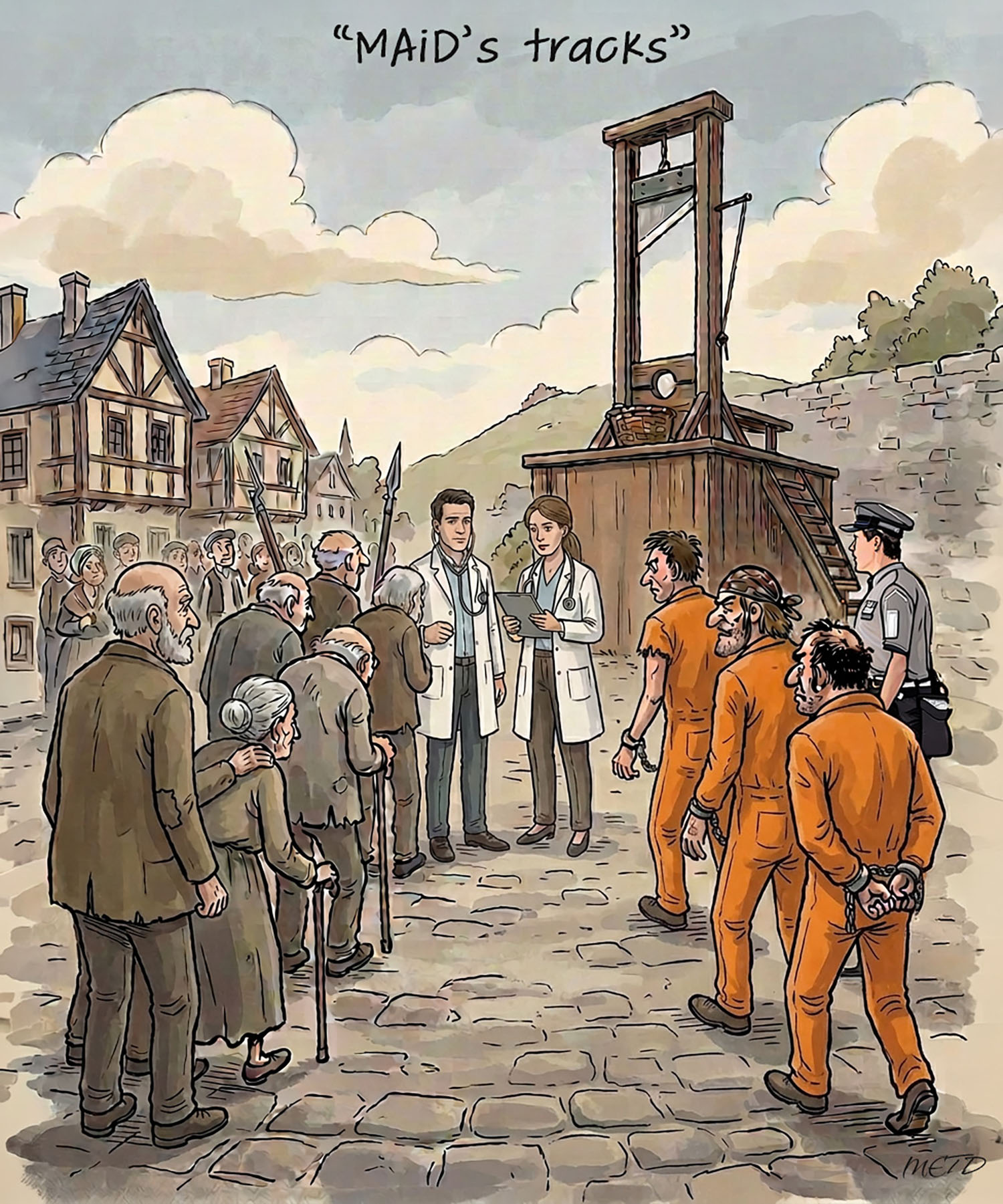
Yet, at the same time the government’s bill would allow advance directives for people with dementia and other cognitively degenerative illnesses to give permission for a health care professional to kill them when they no longer have the capacity to consent. Fraser said that only provinces that wish to permit advance directives would be required to do so. Currently, Quebec permits them while Alberta has outlawed the practice for euthanasia.
C-218 was subsequently defeated 187-141. The Conservatives, NDP, Green Party leader Elizabeth May and just two Liberal MPs, Kent MacDonald (Cardigan) and Marilyn Gladu (Sarnia—Lambton—Bkejwanong), who earlier this year crossed the floor from the Conservative Party, voted for C-218, while almost the entire Liberal caucus was joined by the BQ in voting down the bill.
Fraser said he was concerned about language in C-218 that would “close off access (to euthanasia) to people who suffer from serious degenerative neurological disorders,” which is why the government opposed the bill. Jansen said she offered many times to consult with the government about new language that would get the Liberal Party on-board with C-218.
Jansen said she was disappointed that her bill was defeated as part of a “political game” the Liberals played, and expressed concern about the government’s bill: “We have no idea what (Fraser’s) bill is going to say, he’s saying all sort of things,” said Jansen. “He hasn’t seen the bill himself.”
Alex Schadenberg, executive director of the Euthanasia Prevention Coalition (EPC), said, “Bill C-218 offered Parliament a focused way to protect Canadians struggling with mental illness,” but “instead of sending it to committee for study,
the Liberals voted it down in favour of a promised bill Parliament has not yet seen.”
Schadenberg told The Interim that he is concerned that the Liberal bill’s language about mental illness will not be as strong as that in C-218. He also acknowledged there is a difference between the “permanent” exclusion contained in C-218 and the “indefinite” exclusion promised by Faser, saying that indefinite means the expansion of euthanasia for solely mental illness would still hang over the MAiD regime.
Schadenberg said that until the EPC can analyze the language of the bill, “we will not determine whether the government will actually prevent euthanasia for mental illness as the sole criteria.”
Advance directives
In his press conference announcing the new bill, Fraser said advance directives will “grant access to medical assistance in dying to people who have provided consent at a time when they still have the capacity, but know that they have been diagnosed with an illness that will take that capacity from them.”
But far from providing consent for euthanasia, it disestablishes the idea of contemporaneous consent to be killed. Trudo Lemens, health law professor at the University of Toronto and former member of the Ontario coroner’s MAiD review committee, said that “introducing advance directives for MAiD crosses the line between clear consent and no consent, so it’s certainly no longer a practice where clear consent is the basis for MAiD.”
Association for Reformed Political Action (ARPA) policy analyst Daniel Zekveld said, “Advance consent is not fully informed consent” because “a person with a diagnosis has never lived through the future stages of the condition and cannot know what their life will be like in the future.”
The EPC opposes all euthanasia, including expansion by advanced directives. At a press conference on Parliament Hill, Schadenberg questioned the rationale for advance directives: “Because someone is now incapable of consenting or requesting, it’s a good idea to do this because they might have asked for it in the past?” Schadenberg said there are practical unanswered questions: “Who makes the decision in the end? Some family member? Some doctor who says, ‘Oh, I guess this was requested?”
At the same press conference, Dr. Laurence Normand-Rivest said that people with cognitive problems who signed advance directives might oppose being killed in the moment. “They need to be sedated and they don’t want to get an injection and have an IV, a pick line, placed in,” said Normand-Rivest. “People think that it will be a peaceful death but, in fact, we see a lot of struggle and battle.”
Liberal MP Marcus Powlowski, co-chair of the parliamentary committee on MAiD, voted against C-218 even though he is opposed to expanding euthanasia for mental illness and by advance directive. He warned that advance directives mean that patients will lose their ability to provide consent in the future. “What happens then when I’m 80 and I’m pleasantly demented?” he asked. “I’m enjoying my life, I like watching hockey games, and then what are they going to do? Pull me into some back room, strap me down as I’m yelling and screaming, and inject me with drugs and kill me?”
In 2016, a doctor in the Netherlands ordered the family of a Alzheimer’s patient in her 70s to hold her down because she was resisting a fatal injection. The Dutch Regional Review Committee exonerated the doctor saying he “acted in good faith” because she expressed prior support for being euthanized, although she apparently had changed her mind and needed to be restrained in order to be killed.
Schadenberg wrote on his blog that “euthanasia by advance directive is a very dangerous concept as it would permit doctors and nurse practitioners to kill someone who has become incompetent, based on an advanced request.” The problem is that once someone becomes incompetent, their medical desires, including continuing to live, need not be abided.
Reaction
Conservative MP Andrew Lawton (Elgin-St. Thomas-London South criticized the government: “The Liberal are playing politics with people’s lives.”
The Epoch Times quoted Alicia Duncan, whose mother was killed by euthanasia, condemning the government’s ploy: “MPs must accept both or reject both. Sneaky politics with irreversible consequences.”
Pro-life groups also condemned the Liberal gambit.
Schadenberg said the government’s proposal is a “catch-22 situation where voting ‘no’ to the bill would allow euthanasia for mental illness as a sole criteria [sic], but voting ‘yes’ to the bill would permit euthanasia by advanced directive.” The EPC is calling for the bill to be split so each issue can be considered separately on its merits.
CLC said the government’s bill will be unsupportable if it includes advance directives while purportedly protecting those will mental illness.
CLC national president Jeff Gunnarson said “The Liberal government is playing with lives.” He explained, “It voted down a bill that would protect the mentally ill while claiming it will introduce its own protections,” yet “on the same day, it says it plans to make euthanasia more available for those suffering from dementia.” Gunnarson said, “The Liberal government is still bent on expanding death – it just changed its target.”
ARPA’s Zekveld said the government “should not hold the mental illness exclusion hostage to an amendment that would permit advance requests for MAiD.” He said “protecting Canadians with mental illness from MAiD should not come at the expense of Canadians with dementia and other capacity-limiting illnesses.”
Zekveld said that Parliament has studied mental illness eligibility extensively but not advance directives.
The Evangelical Fellowship of Canada said it was “unfortunate” that C-218 was defeated and “we regret that it did not pass.” They expressed concern that the government plans to introduce advance directives for provinces that choose to allow them. “The EFC’s response to this future legislation is likely to be nuanced” because “we strongly support an indefinite delay of MAiD for mental illness and have advocated extensively for this,” but “at the same time, we have grave concerns about allowing advance requests.”
Inclusion Canada, a group that advocates for people with intellectual disabilities, praised the government for “listening” to concerns about expansion of MAiD for mental illness but is concerned about advance directives because patients may not understand what is happening to them at the time of the lethal procedure: “Consent at the time is the most basic protection a person has.”
The Cardus think tank said it was “encouraged” by the indefinite expansion but opposed the expansion of euthanasia through advance directives. Its statement said, “This change would heighten the risks of MAiD provision for patients and providers” and “would compromise rather than protect informed consent, which is a core safeguard in the current MAiD regime by undermining the present agency of a patient in favour of their past decision.”
Cardus said the legislation should be split, “separating any discussion of advance requests from this fall’s legislation to ensure MAiD for mental illness is indefinitely delayed in time for March and to allow further, fulsome discussion of advance requests.”
When asked asked if he would be open to splitting the bill, Fraser indicated he would not. He said, “although it’s nice to collaborate and take the perspectives of different parties, democracy doesn’t demand unanimity.”
If the government’s bill does not pass, patients’ whose sole underlying condition is mental illness will be eligible for euthanasia beginning on March 17, 2027. Parliament recesses from Dec. 12 to Jan. 24, and has two more one-week recesses between late January and mid-March.
Scott Hayward of RightNow said that “stopping MAiD for mental illness would be an enormous victory,” but questioned any other expansion of the bill. “We will judge this legislation by a simple standard: does it protect more vulnerable Canadians from euthanasia, or put more of them at risk.”
The pro-euthanasia Death with Dignity called Fraser’s announcement “profoundly disappointing” despite the fact it has lobbied the government to permit advance directives. It claims that it is discriminatory to allow euthanasia for physical conditions but not mental ones.
Dementia Justice Canada has expressed concern over advance directives saying that Parliament must determine whether it can enact adequate safeguards to protect people living with dementia from coercion and undue influence signing documents at the urging of family members rather than their own wishes.
When The Interim went to press more than three weeks after Fraser announced the government would introduce the bill, it had yet to be tabled.