God on Stage: 15 Plays that Ask the Big Questions
Peter Kreeft (Word on Fire, $32.50, 216 pages):
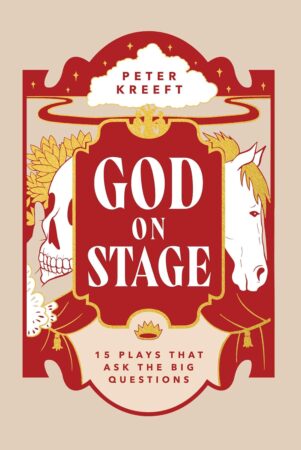 Peter Kreeft’s God on Stage examines 15 plays, three each on five different themes (life and joy, relationship with God, suffering, death, damnation), one that is pre-Christian, one Christian, and one that is post-Christian. Kreeft says “reading and reflecting on great dramas, great plays, is a powerful way of expanding our world and expanding our interactions with it, and therefore expanding ourselves.” Through Dylan Thomas’s Under Milk Wood (technically a radio drama), Thornton Wilder’s Our Town, and Samuel Beckett’s Waiting for Godot Kreeft examines the “meaning of and attitude toward human life as a whole.” Beckett’s nihilism is a dark abyss while Thornton’s play shows that love, light, and life are “stronger than death.” With Prometheus Unbound (Aeschylus), A Man for All Seasons (Robert Bolt), and Equus (Peter Shaffer), Kreeft examines questions about the relationship between man and God – religion. About Thomas More’s refusal to give in to King Henry VIII and violate the teachings of the Church, Kreeft says “More has already given his soul to Christ; that is why he must keep it.” A Man for All Seasons – the play and the excellent movie, a rare example of a play that is better as a movie – illustrates why conscience cannot be merely (in Bolt’s unfortunate words) “private,” but bound to something larger than oneself. More, in Bolt’s telling, famously says “when statesmen forsake their own private conscience for the sake of their public duties … they lead their country by a short route to chaos.”
Kreeft explores the role of suffering through Sophocles’ Oedipus the King, William Nicholson’s The Shadowlands, and Archibald MacLeish’s retelling of Job, J.B. Oedipus, Kreeft notes, is both wise because he solves a complex riddle but also unwise because he “tries to master his own fate.” Every story, including ours, features “two forces … namely, free choice and destiny.” That is, we are products of our environments and free will. Oedipus committed his moral crimes unwittingly – he did not know the man he killed was his father, the woman he married his mother – but he still had to suffer for his and his kingdom’s redemption.
Kreeft examines death in Shakespeare’s Hamlet, John Henry Newman’s The Dream of Gerontius (a poem), and Cormac McCarthy’s Sunset Unlimited and damnation in Shakespeare’s Macbeth, C.S. Lewis’s The Great Divorce (a novel), and John-Paul Sartre’s No Exit. Kreeft says that paganism is closer to Christianity than is post-Christianity because the former led to Christianity while the latter consciously left Christianity in its wake. Shakespeare’s plays, Kreeft argues, stand between pagan and Christian in a way that most post-Christian plays and novels cannot stand halfway between Christian and post-Christian culture.
Kreeft says that our crisis, as John Paul II knew, is a “crisis of anthropology, of human nature, of ‘know thyself.’” Fine literature, including plays, can help us understand ourselves and our relationship with the world and, more importantly, with God, if we are more than passive consumers of the art. Kreeft will help you be such a viewer for 15 essential plays.