In their university philosophy classes, undergraduates are sometimes asked to grapple with thought experiments. The so-called “trolley problem,” for example, places an observer in view of an out-of-control locomotive. This on-looker is also, somehow, located at a switch which will divert the runaway train’s course and reduce the number of casualties—at the cost of the moral agent making a direct intervention. What is to be done? Abstain from action? Or sully oneself to mitigate greater harm? The notorious “ethicist,” Peter Singer, used a similar example with his “drowning child” scenario to shame respondents— who affirmed that they would intervene to rescue a nearby child in distress— for not supporting NGOs tasked with similar missions in faraway places. Both of these famous instances are modern day “spiritual exercises” which either impose on their recipients a coarsening compromise, or establish a set of contrived and coercive set of conditions to precipitate a desired outcome.
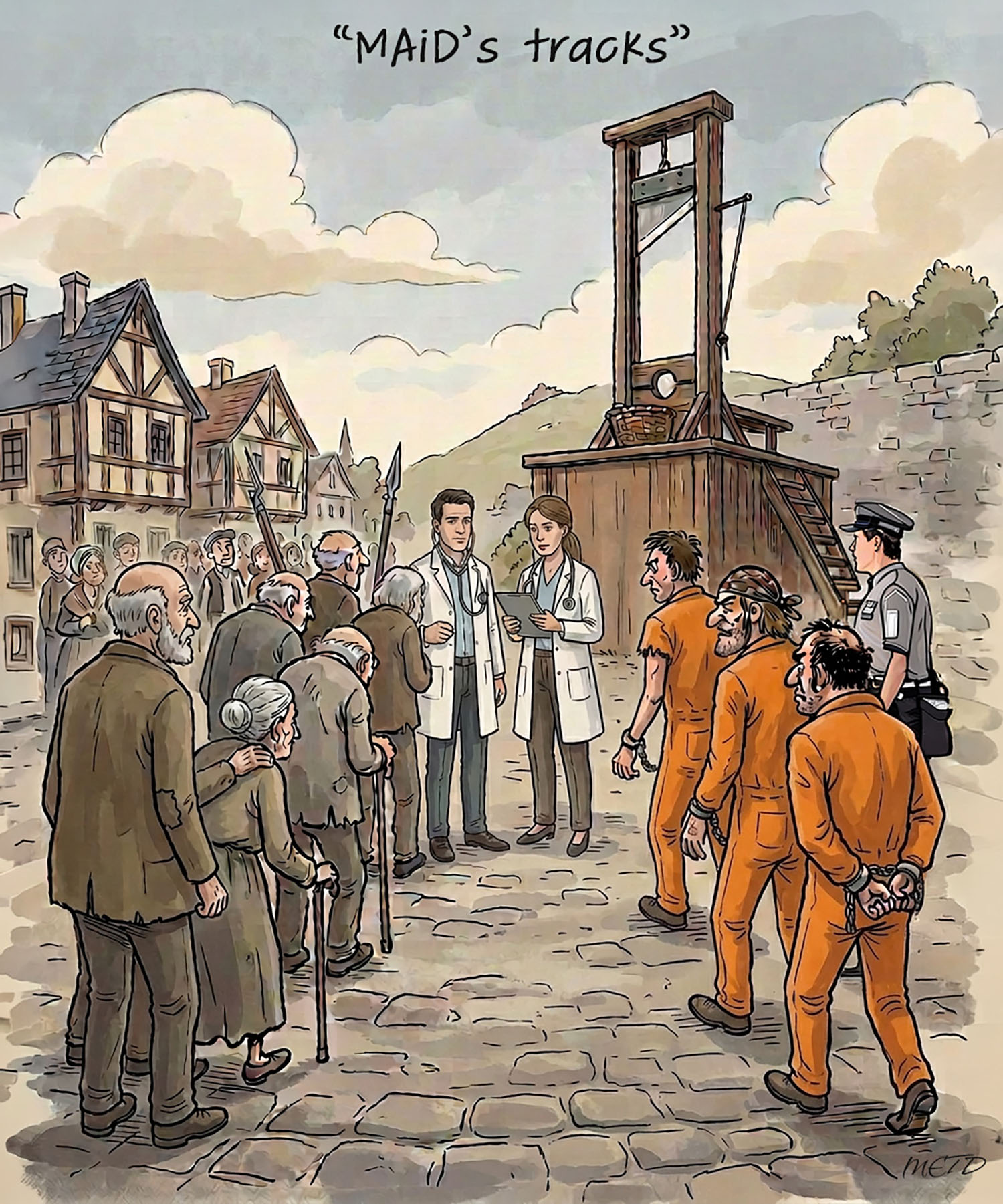
This manipulative intellectual practice has an obvious analogue in the realm of politics in the form of policy changes which are offered with the sham of safeguards and exceptions. Abortion, historically, has been the classic example of this, as it was initially advanced in many Western countries for the sake of the “life of the mother.” This seemingly firm restriction was then quickly expanded to become the “life or health”—and so it has gone in other realms as well. Euthanasia was introduced as a rare but legal option only for the terminally ill who were suffering grievous pain. But, from the margins of the rare and the exceptional, the movement always marches to the centre. And here we are: Medical Assistance in Dying is now one of the leading causes of death in Canada, and it now threatens children and the mentally ill—that is, a constituency which has long been recognized as being unable to make life-altering decisions and a category of afflicted people whose very ailment constitutes the desire to seek an end to their affliction.
And so, we come to the base of the slippery slope about which we had been warned so often in prior years. Limits, controls, precautions, and exceptions—all of these appear, in retrospect, as the duplicitous concessions of activists made for the sake of otherwise abhorrent practices becoming legally and socially acceptable. Their familiar strategies are always the same: the minimization of the projected harm, the amplification of purported good, and the fallacious clothing in the guise of compassion. And yet, by sacrificing the principle—in the one case, the sanctity of unborn life; in the other, that the vulnerable must always be protected—inevitable consequences have followed. MAiD, in particular, has made Canada infamous on the world stage for the sheer scale at which it allows its own citizens to liquidate themselves.
To reverse this trend, we need to return to the sanity of first principles and point out the obvious lies that have brought us to a place that the purported “safeguards” and “exceptions” should never have allowed. These, though, were always lies. To re-establish the legal protection of life at all its stages, we should begin by decrying the coercive deceptions that have enabled our society to be so coarsened in the first place. Principle, after all, is the ultimate safeguard—and the compromise of principle is, by definition, an evil which should always be opposed.