Sarah Stilton, Review:
The Dignity of Dependence: A Feminist Manifesto
by Leah Libresco Sargeant (Notre Dame University Press, $37.95, 219 pages)
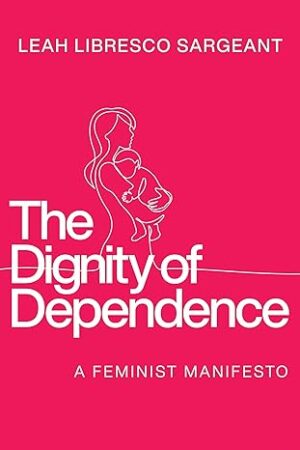 Leah Libresco Sargeant, an author and speaker, provocatively argues in her brief The Dignity of Dependence: A Feminist that it is not women who form families by choosing marriage and motherhood that betray the sisterhood, but rather radical feminists who ignore or hide women’s sexual distinctiveness. Rather than join the male-dominated world of the political economy, women are designed, through the interdependent nature of female fertility and other facts about the body, for the organic ecosystem of hearth and home. Human beings, but women in particular, are not interchangeable parts, widgets that efficiently fit into the vast, impersonal machinery of economic world of management, labour, and consumption, designed for otherwise unattached individuals. We, as human beings, are highly interdependent parts of a whole.
Sargeant argues that women’s biological needs – fertility and child-bearing chief among them, although they hardly exhaust the list – are penalized by current socio-economic arrangements. Sargeant has a long list of everyday items that, at best, inconvenience women, and, at worst, endanger them, due to the male-dominated norms, from countertop heights to car safety systems. While there are some attempts to counter these norms with feminist perspectives, in practice, Sargeant says, women turn against their own bodies and “prune themselves” to fit in. The goal, she says, seems to be to “make women better men,” which comes at a great cost. Is it not better to allow women to be their best selves, as women, rather than to out-compete men in a system apparently rigged against them?
Sargeant says that “making fertility optional and exceptional” so that women can compete with men appears to be leveling the playing field, and there is no shortage of progressive politicians, especially Canada’s feminist former prime minister Justin Trudeau, who are convinced that birth control and abortion are the key to unlocking women’s equality in the world of work and business. From breast pumps to contraception to abortion, women are asked to overrule their own biology for the sake of competing with men: “Women are asked what kind of assistive devices might help them navigate a world with no room for who they are.” Paradoxically, these “demands don’t come from men or from people hostile to womanhood,” but “women who aim to help other women.” Put less ladylike, “it’s a woman’s period that poses the threat of holding her back,” so some women advocate using period-suppressing birth control to decrease or eliminate their periods. There are, however, serious side-effects in doing so, including decreasing detection of real pathologies. Long-term period suppression, artificial contraception, and abortion, and perhaps soon artificial wombs, present women’s bodies as their own enemies. “Our cyclic changes and seasons of vulnerability,” Sargeant writes, “are treated as design flaws.” This sounds more like misogyny than feminism.
Despite the fact that this anti-woman feminism is closely aligned with left-wing causes, including Soviet communism, it is, in fact, corporate-friendly: it is cheaper and easier for businesses and government to have women neutered than it is to meet their uniquely embodied needs. If the state or an employer is going to pay for abortion and birth control, it signals, rather forcefully, that women are responsible for any children they might choose to have.
Interdependence is countercultural, a sign of vulnerability in a world that prizes autonomy and individuality. Sargeant says of the “dream of external wombs” that it “feels more possible to create biological support for a child in the absence of a mother than to win the social support required to sustain the presence of a mother.” That is a damning indictment of the current socio-economic system throughout most of the world, but especially in the “enlightened” West.
Interdependence welcomes the “network of uncalculated giving and graceful receiving” – that is, non-transactional relationships between people. These features of interdependence animate healthy communities and families, and while Sargeant largely eschews politics, one wonders whether a socio-political environment that co-existed with interdependent communities would be more civil.
Sargeant’s solution is for men and women to embrace the gift economy of asking for, receiving, and giving help in a non-transactional way. But is this possible on a scale larger than the family or tightly knit small communities such as a church or neighbourhood? A mindset-change among people to see burdens as blessings in which greater human connection can be nurtured might be too much to hope for considering mankind’s fallen human nature. Yet the goal of being “defined more by our relationships than by our liberty” would benefit more than women by nurturing the desperately needed interdependence through which true human flourishing can occur.
Sarah Stilton lives in London, England, and studied the classics at Oxford and Harvard.