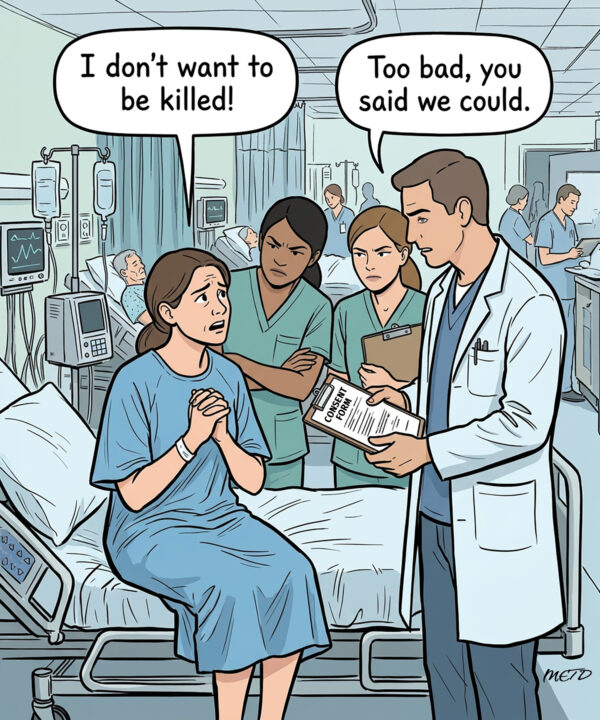
 A woman expresses a desire to participate in an activity at some future date—when, in her words, “the time was right.” This statement is taken to constitute “prior consent.” When the activity actually begins, however, the woman starts resisting. At this point, a soporific drug is secretly slipped into her drink to ease things along. But the drug proves insufficient: the woman continues to resist quite strenuously—so much so that the activity can only proceed once she has been restrained.
This deeply unsettling description is not the account of something that transpired in a college frat house. Instead, it sketches the uncontested facts of a controversial case of euthanasia which occurred in the Europe 10 years ago. The incident caused an outcry even in the famously permissive Netherlands where legal protection from medical murder for the elderly, the infirm, and the vulnerable had long been abolished. In the end, however, the female Dutch doctor who administered both the surreptitious drug—which was mixed in with the victim’s coffee—as well as the final, fatal injection was cleared of any wrongdoing.
Had the activity in question not been euthanasia but, instead, a sexual encounter, the outcome of the inquiry would have, undoubtedly, been different; in fact, the very notion of “prior consent”—or advanced “request” or “directives” as it also called—makes the troubling parallels between cases of euthanasia and sexual assault inevitable. Indeed, the moral clarity that is still so easily reached for crimes in the latter category should guide us to reject the former as well—and for the very same reason. For “prior consent” can never justify violations of personal autonomy, especially in cases where the vulnerable have lost either their capacity—or even simply their legally recognized right—to change their minds. For this reason, any legal regime establishing a mechanism for “advance requests” for euthanasia would, if the same criteria were applied to sexual assault, be rightly decried as fostering “rape culture.”
Yet the federal government is moving to expand MAiD in precisely this way, making it available for “advanced request.” Tamara Jansen, a Conservative MP from British Columbia, recently sponsored a private member’s bill that would have made it illegal to administer euthanasia in cases where mental illness was the sole criteria. Despite the growing awareness that MAiD is becoming an international scandal, this bill was defeated because all but two of Mark Carney’s Liberals voted against it, following the government’s announcement that it would introduce legislation along the same lines. But their promised modification of the law will also create a pathway for “advanced requests.”
By definition, such requests are a contradiction in terms; it is impossible to will one’s own demise in future circumstances, because the very point at which any advanced directives could be enacted is also the point at which meaningful consent in the present can no longer be given. This is an important point to stress, because the idea of an advanced directive conjures images of injured, comatose, or otherwise incapacitated patients with “do not resuscitate” orders. But there can be no comparison made between such situations, because diminishing mental capacity does not eliminate the will to live—an instinct on strong display in the notorious Dutch case mentioned above, and which clearly makes rape, the true parallel to consider.
After all, consider the climate that these directives—whether actually made in writing, or merely alleged by impatient family members who wish to be relieved of the burdens of long-term care—will create: they will menace not simply those who sincerely but wrongly believe they can fully consent to a future act. Instead, the specter of advanced consent will cast its shadow over all of the vulnerable in care homes who suffer from ailments like dementia. Any legal recognition granted to advanced directives will allow for the medical murder of the incompetent, of people who, by every legal definition, are unable to render consent at the only moment when it matters.
Therefore, to establish a regime which defers to “prior consent” is to create a legal climate in which victims are deprived of the right to change their mind. Moreover, the incompetent will soon be deprived of the right to life by default. If, for example, the diminishments of age only impair to the infirm to express their wishes, what is to prevent the unwilling liquidation of victims who have only temporarily lost their ability to communicate? And, even in cases where an incompetent citizen has not expressed prior consent, what legal protection will really remain? The murder of those who express prior consent assumes that, in their current state of incapacitation, they would not change their minds; what will then prevent a family member or a medical professional from affirming that anyone who didn’t make such a declaration, but who finds themselves rendered incapacitated or incompetent, would, given the choice, make that decision now? The “past self” will quickly become the present proxy or medical expert who makes the fatal decision for them; in every case, the sentence of death will be passed on a victim who is currently unable to give meaningful consent of any kind.
It is now common to refer to the victims of sexual assault as “survivors,” but there can be no survivors of non-consensual euthanasia. There will never be a #MeToo movement for those who were coerced or pressured into MAiD—for whom putative consent was feigned, forged, or forced by other interested parties, or simply by professionals who have arrogated to themselves the godlike power of deciding who may live and who must die.
Under the guise of making a long-overdue common-sense amendment to the criminal code, Mark Carney’s Liberals are poised to usher in a paradigm that will make non-consensual murder completely legal in Canada. If we are still able to recoil with horror from the unspeakable actions of rapists, why would we ever contemplate the amendment of laws that would make fellow citizens who are no longer able to give their consent vulnerable to murder? Those who lack the means to change their minds must have their right to bodily autonomy respected. If prior consent is no defense for the brutal actions of a rapist, it is hardly the criteria that Canada should establish for medical professionals who have charge of the incompetent. As the saying goes, there is no excuse for abuse.