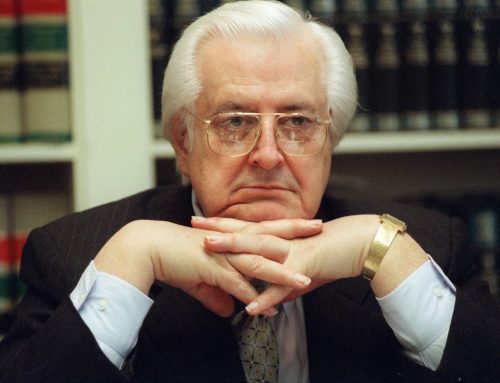
On December 4, 1984, Attorney-General Roy McMurtry announced that the Crown would appeal the jury’s November 8th decision to acquit Morgentaler and his two medical associates, Robert Scott and Leslie Smoling. In a 17-page statement read to the Ontario Legislature, McMurtry explained that, “the case raises fundamental issues about the jury in our system of criminal justice.” The “legal advice I received is unanimous,” he said, explaining that the appeal “has nothing to do with anyone’s personal view on the issue of abortion.”
One does not have to question the Attorney General’s word that politics were not directly involved, to realize that events during the month-long waiting period between the date of acquittal and the announcement of appeal were, nevertheless, of significance. The decision to move the case to a higher court did not come in a political vacuum. Two things happened during these four weeks: first, the building of pressure for and against appeal, and, second, a growing realization that something in the legal process, especially the selection of the jury, had gone wrong.
Summation
On November 8, the Toronto trial had a surprising ending. One week earlier on November 1, Morgentaler had been the last witness testifying on his own behalf, explaining to the jury that he broke the law to help people. “I am sensitized to suffering,” he said. “I am sensitized to injustice. I have suffered in the German concentration camps.” Crown Attorney Alan Cooper tried to diminish the testimony’s impact, by showing that Morgentaler also stood to make a great deal of money. (See box elsewhere in this issue.)
On November 2, Morris Manning presented his summation based on the defence of necessity. He argued that the present law “takes away the right of women to decide” and that the many applications for abortions with the Morgentaler clinic indicated a true existing need. What you have to decide, he told the jury, is the question: “Is this a good (abortion) law or is it a bad law?”
Alan Cooper, on the other hand, explained that “necessity” must have an element of immediacy, such as in the case of a starving person stealing food. No such immediacy, he pointed out, could be found in Morgentaler’s actions. After all, he had announced his plans eight months before he actually opened his clinic in June, 1984. As for the law, Cooper stated, the jury was not to judge the law but to form a judgement according to the law. Moreover, “breaking the law to change the law is plunging a knife into the very heart of democracy.” Until a law is changed democratically, it remains the law, he added. “If you acquit, this is an invitation to anarchy.”
After these summations on Friday, everyone expected the jury to begin deliberations on Monday, November 5. Instead Morris Manning vehemently objected to Judge Parker’s four-hour-long instructions to the jury that day, which included the admonition that “I think it is improper for a lawyer to suggest to a jury that they should break the law… Your duty is to decide the facts and then apply the law. You are not here to judge the law, and you have no right to do so.” Manning’s objections led to objections from the Crown Prosecutor as well and, ultimately, to a whole new set of instructions, delivered on Wednesday, November 7, by a tired Judge who had worked throughout the night re-working his ideas. Mr. Justice Parker apologized several times for a halting presentation. At one moment he told the jury that unless they were unanimous in holding the accused guilty, they would have to vote for acquittal, thus improperly eliminating the possibility of a hung jury. This jury, meanwhile, had spent most of Tuesday in a small room trying not to discuss the case and now had to listen to another long re-charge which, after they had been sequestered for their deliberations, was denounced once again by Manning as “biased.”
Acquittal
The November 8 acquittal came as a great disappointment to Morgentaler’s opponents. There had been a certain confidence, especially among those not aware of how the jury had been selected, that Ontario juries would not repeat the Quebec example. Those who had kept close tabs on Manning, however, feared that this might not be so. They had been aware of an attempt to discredit the Crown Prosecutor in August, charging that he had indirect connections with pro-life. When that failed, they watched Manning’s successful exclusion, by the use of two professionals specializing in jury selection, of whole categories of Canadian citizens who might be inclined to disapprove his client’s aims and tactics. As the two women put it after the acquittal, they had attempted to eliminate regular churchgoers, housewives, young people and older professionals. (“Religion called key in selecting juror,” Star, Nov. 9.) On a visit to Toronto and to the court where the trial was being held, Joe Borowski had put it more graphically: “That jury is pro-abortion. I bet you money Morgentaler won’t get convicted,” adding, that Manning had done everything but administer saliva tests to the potential jurors. (Globe and Mail, Nov. 9.)
Action
“It’s a black day for Canada,” said Jim Hughes, national president of Campaign Life, of the acquittal. However, despite the blow, pro-life supporters in Toronto moved quickly. Phone calls began to pour into Roy McMurtry’s office. Letter-writing campaigns got organized everywhere: in parishes, high schools and by numerous individuals on the understanding that the Attorney General was to make a decision for or against appeal by Monday or Tuesday of the following week. One of the larger Pentecostal churches had a form letter printed with detailed objections to the trial and had 2,000- signed copies delivered by Monday morning. By that time the Attorney General’s office acknowledged receiving over 2,000 phone calls.
Print Media Response
Newspapers across the country reported the Morgentaler acquittal on their front pages. “Jury acquits Montreal M.D., 2 co-accused,” read the Montreal Gazette and “Morgentaler acquittal means politicians face hard decision.”
“Morgentaler to re-open Toronto abortion clinic,” stated the Ottawa Citizen, while the Winnipeg Free Press brought proof that ‘jubilant’ supporters celebrated the victory at Morgentaler’s Corydon Avenue clinic in that city, by printing a photo of a group of young women talking animatedly in front of “pro-choice” posters. The Regina Leader Post headed its story “Wins again, Victorious Morgentaler vows to re-open Toronto clinic.” Meanwhile, local and national radio and TV news services raced for Morgentaler interviews from friend and foe alike to fill their news slots with the latest quotes and the most recent commentary.
The Toronto newspapers, especially the Globe and Star, played up the Morgentaler victory for all it was worth. For days his picture appeared on the front pages: Morgentaler being kissed by Selma Edelestone (who he describes as his publicist); Morgentaler flashing a “V for Victory” sign, Morgentaler and Manning holding up hands in triumph; Morgentaler and Scott doing the same. The headlines suited the occasion.
“Morgentaler Acquitted,” bannered the Star over the entire width of the paper. “Morgentaler is jubilant…” read the Globe, adding other titles such as: “Clinic is offered to Ontario as training projects for M.D.’s;” “Doctor expecting stepped-up campaign from opponents.”
Under the last heading a Globe reporter quoted Morgentaler as saying of his trial, that it was “a fight between light and darkness, democracy and totalitarianism.” The “anti-abortion people will step up their attacks,” he said. “They are pretty desperate – they have lost the battle. In desperation they might do what they did in the United States: commit violence against clinics and slander me even more than they have.”
Morgentaler did not think there would be an appeal. However, his Toronto supporters such as Dr. Marion Powell of the Bay Centre for Birth Control and past president of Planned Parenthood Toronto as well as a former member of the Badgley Committee, and University of Toronto law professor Bernard Dickens, were not as optimistic as Morgentaler himself. Said Dickens, “The Government responds to powerful forces in this country. As long as people like Emmett Cardinal Carter are closely linked to movers and shakers in the Conservative party, the law is likely to be strictly enforced.” (Globe, Nov. 9)
Naturally, other Morgentaler supporters did not remain idle. The NDP justice critic, MP Svend Robinson, called a press conference in Ottawa. Other politicians took more time to express views for or against new federal legislation or an Ontario appeal. (See “Morgentaler and House of Commons elsewhere in this issue.)
Editorials
Editorial writers of some daily newspapers however, threw themselves quickly behind Morgentaler, beginning with the Toronto Globe and Mail. The Globe’s editorial “Abortion Acquittal” (Nov. 9) argued that the Criminal Code had not applied in Quebec since 1976; that now the same message had been delivered in Ontario; that further prosecutions were useless; that the jury had spoken and that the judgment of the four juries together required Parliament to act immediately to make abortion a matter between “prospective parents and their doctors.”
The Ottawa Citizen, also of November 9 (“Juries show way”), took very much the same line. It argued that the latest “acquittal was simple justice,” quoting Morgentaler that “it is not a criminal act to help people.” It was a “jury of ordinary citizens” which had provided the judicial triumphs of Morgentaler and any further appeal of prosecution would represent “judicial harassment.” The Ontario Government must accept the reality that the law is unenforceable and recognize “the legitimacy of free-standing abortion clinics.” As for the federal parliament, the Citizen stated that, “despite the lack of clear public consensus, reform of the abortion law must come as a priority.”
The Winnipeg Free Press, too, joined the abortion on demand supporters. In “abortion and the law” (Nov. 10), it argued that the 1969 amendment had been “an inspired piece of hypocrisy,” permitting abortions for health reasons but knowing that “health” could permit “an abortion for almost anyone who asked.” Morgentaler and the last fifteen years have shown that government “can only pretend to control the performance of abortions by qualified medical practitioners.” Hence, “it becomes increasingly clear that abortion is a matter best left to a woman and her doctor.” However, it concluded that, “given the depth and sincerity of feelings on both sides of the issue, government is likely to cling to the present compromise.”
The Vancouver Sun thought the matter simpler than that. “The acquittal of Morgentaler,” it said, “sent a clear unequivocal message to Justice Minister John Crosbie and his parliamentary colleagues.” The paper concluded: “There is only one safe way to eliminate the inequity, and that is to remove abortion from the Criminal Code and let women make their own decisions on the advice of their doctors.”
Although to many the legal dilemmas seemed almost insoluble, other newspapers were not quite as prepared to let the reins go completely. The most liberal of this group was the Toronto Star. In its November 9 editorial “Change the abortion law” it declared that the decision of four juries had made Canada’s abortion law unenforceable. However, parliament should re-write the law, it said, by establishing regional therapeutic abortions committees rather than hospital by hospital. Meanwhile, abortions should be permitted to be done everywhere. While waiting for a new federal law, Ontario should permit abortion “clinics to be licensed as hospitals.”
The Montreal Gazette in “Give Life a Chance” (Nov. 10) argued that it should not accept the view of “the pro-abortionists” who “insist the right to an abortion is so absolute that a woman need only ask and it shall be done.” Somewhat pathetically, perhaps, it pleaded for a “minimum waiting period, perhaps 48 hours, between the time a woman applies for an abortion and the operation,” and for giving life “a last chance” by obliging clinic staff “to provide objective information about public and private child support systems, maternity benefits and adoption services.”
The London Free Press (“The Law in Limbo.” Nov. 10) also squirmed unhappily between what appeared to the editor as an unenforceable law on the one hand and “pro-life advocates” who argue that already the law is a license to kill,” on the other hand. The government, it thought, “has an obligation to draft new legislation.” However, “it should continue to confine abortions to accredited hospitals, rather than allow the uncontrolled proliferation of private clinics, but it should dispense with the therapeutic abortion committees which are turning a blind eye to the letter of the law anyway.”
The Hamilton Spectator in “Time for a second Look,” Nov. 12, felt that the onus for clarifying Canada’s controversial abortion law “was now back where it belongs – in Parliament.” Like other editors who did not notice the contradictory elements of their editorials, it offered the opinion that “a newly-revised law must continue to ensure that abortions are regulated and supervised on a therapeutic basis, but the decision-making process should be left to the parents and their physician.” As if one contradiction weren’t enough, it added a second one by asserting that the present unsatisfactory law was “the closest we’re likely to come to a consensus,” while at the same time accusing Federal Justice Minister John Crosbie of a “cop-out” for saying that there was no social consensus on how to change the law.
Legal heritage
Finally, one newspaper challenged the Morris manning statement delivered after the acquittal that “This is a clear message from the jury to the politicians of this province and this country that this is what the people want.” In its November 10 editorial “Parliament’s job,” the Kitchener-Waterloo Record wanted to know the following:
“But why does Manning think that a jury is more capable of determining what is “right and proper” than a parliament that represents all men and women in Canada? And what would he think if, in the future, another jury decides it is “right and proper” that no abortions should be performed? If 12 Canadians on a jury have more power to determine what laws should be enforced than 282 MPs our democracy is in trouble.”
The Record editorial brings us back to the real issue, namely the legal heritage – or should we say the legal shambles – with which Morris Manning has left this country. It is to the credit of Pro-Life that it succeeded in drawing attention to this issue despite the hostility of editorial writers and feminist columnists such as Lynda Hurst (“It’s time Morgentaler’s victory was recognized,” Star, Nov. 12), Laura Sabia (“Hypocrisy at its worst,” Toronto Sun, Nov. 13), June Callwood (“Jury trials: an endangered species,” Globe, Nov.15), and Doris Anderson (Star, Nov.24). Numerous letters to the editor throughout Canada focused attention on Manning’s attack on juries and the law during the weeks following the acquittal. As Roy McMurtry postponed his decision originally announced for November 13, the media simply could not avoid the legal issue.
“An impartial jury”
The one who put it most clearly was Anglican Bishop Arthur Brown (“Morgentaler decision must be appealed,” Toronto Sun, Dec. 2). “I personally cannot recall another trial in Ontario, within living memory,” he wrote, “when the accused confessed to disobeying the law and then was pronounced ‘not guilty.'” At issue here is … “our whole system of justice and law.” “There is surely no excuse for a jury, dealing with a self-confessed person who breaks that law, to declare that person not guilty.” Even more serious was the reported selection of the jury. “What we have in the Morgentaler trial is not a jury representing Canadian society as a whole, but a small segment. Why on earth the Crown allowed this to happen is beyond my comprehension. The whole proceeding needs scrutinizing and review – and as quickly as possible. “On December 3 the Hamilton Spectator published the editorial, “an impartial jury,” in which it made clear that Manning’s “selection” process raised more questions than answers.
Meanwhile, on November 23, Ontario Health Minister Keith Norton rejected (again) Morgentaler’s offer of a free abortion clinic as a pilot project and also designated a “hospital,” despite editorials in the Globe (Nov. 14), and the Toronto Star (Nov. 9, Dec. 6.)
For the weekend of November 23, Gerald Emmett Cardinal Carter issued a pastoral letter on abortion to be read in churches throughout the Toronto Archdiocese. It was a strongly worded rejection of Morgentaler politics. (“Abortion law flouted, Carter says,” Toronto Sun, Nov. 26; “Fight Abortion Cardinal urges Toronto Flock,” Globe; “Abortion is killing innocents, Carter says,” Star, November 16.)
Morgentaler’s “offer” to meet with the Cardinal, to discuss ways to calm the passions and hysteria gripping the anti-abortion movement, was dismissed by Cardinal Carter as a publicity stunt. It was described by Mrs. Laura McArthur of Right to Life Toronto and Area, who had watched Morgentaler many days in court, as “extremely funny, it’s kind of made my day. It’s just another ploy of Morgentaler to get into the limelight. He can’t survive very long without the press or cameras. If you take away the press and cameras from him, you have a very morose, very sad, very pathetic creature sitting in a chair. I’ve seen him many times.” (Globe, Nov. 28.)
By now other politicians, too, decided to speak out. On December 2, the Ontario Solicitor-General, George Taylor, didn’t think that juries had the right “to set laws.” Therefore he announced that the police would lay new charges if and when Morgentaler opened his clinic. “I don’t see that we have any other choice,” he said.
On December 4, Ontario’s Attorney General announced that the Province would appeal.