 A sportscaster is fired; a talking head offers a groveling apology; a media figure makes headlines for recently uncovered remarks. In each case, a crowd brays for punishment and either delights in destruction or slinks away unsatisfied. What we call “cancel culture” seems like something exquisitely modern, a contemporary ritual emerging only at the intersection of celebrity, technology, and the enduring dynamics of human nature. But the roots of this phenomenon are depressingly deep. The pages of history teem with tawdry episodes of murderous mobs singling out certain people or peoples as the arbitrary objects of their violent attention. Ancient phrases like the “scapegoat” and “bread and circuses” have survived, in our languages, for good reason. The rituals of rejection and humiliation one finds in the media today are, in fact, reenactments of primal pageants that recede from view in moments of stability and peace. The scripts for their performance, however, never change—and never completely disappear.
Nor is real or metaphorical mob violence the only form which “cancel culture” can take. The English word “cancel” derives from a Latin root which refers to a “lattice,” and draws its meaning from the visual appearance of a crossed-out word. Indeed, the word “cancel” survives the migration from the age of manuscripts to the era of the printing press, becoming a term for both the eliminated or substituted pages of a printed book. While the way that a bookmaker “cancels” differs from that of the mob, a strong similarity persists: the heckler’s veto and the tyrant’s fiat are both forms of raw power exerted over any offending aspects of reality itself. As one historian observes, noting a parallel in the infamous Russian dictator’s murderous policies and his long history as a newspaper editor, “Stalin excised people—indeed whole peoples—out of the manuscript of worldly existence.”
With this dark legacy in view, one cannot be complacent about the prevalence of “cancel culture” in our own culture. While this two-part term is usually read as a noun and its modifying adjective, it would often be more apt to take the phrase as verb and object, since the aim of “cancel culture” is really to cancel culture itself. All of the most egregious examples of off-color remarks or jokes in bad taste are merely the charged “hard cases” which justify the principle of the cultural death penalty. Once this principle is accepted, anything which fails to adhere to an ever more stringent standard of radical values needs to plead for its very life. But how did we accept so quickly this dangerous idea? What precedent has allowed our cultural inheritance—from books to statues to prominent politicians—to be eliminated so easily?
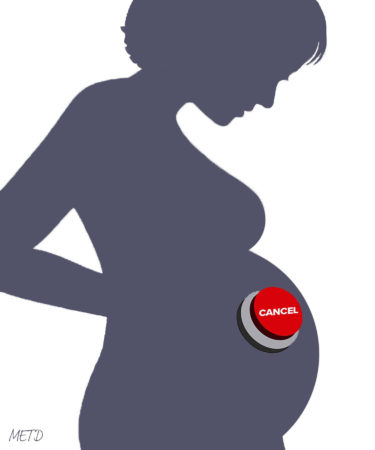
There are many ways to approach these complex, nettlesome questions, but one answer above all needs to be offered. Abortion and euthanasia were the “proof-of-concept” for cancellation in the Western world. The unborn and the elderly have for too long been deprived not simply of participation, but of protection for their very lives. Recent developments in Canada testify to this fact. Some commentators have been rightly alarmed by the speed with which basic civic freedoms—of speech, assembly, and political participation—have been squeezed, if not suspended outright, in recent weeks and months. But the unrecognized antecedent to these outrages is the ongoing and enduring violation of the right on which all of these other rights depend: the right to life. Abortion and euthanasia—those barbarically cruel acts by which the weak and the vulnerable are excised from human existence—are the basis of all of these subsequent denials. Any culture that begins to violate the right to life vandalizes all others soon enough.
In other words, the cancellation of life may start small—indeed, infinitesimally small in the case of discarded human embryos—but it takes on titanic, tyrannical proportions eventually. The culture of cancellation is simply the culture of death working through the realm of human achievement, applying the logic of abortion and euthanasia to cultural products which are deemed “unwanted” or “burdensome.” For this reason, it is not enough simply to oppose this now-famous, visible form of wanton destruction, but to link the iconoclastic bloodlust one finds in newsprint and in newsfeeds with the even more egregious destruction of life at its beginnings and its ends. Being authentically pro-life is the most powerful opposition to cancel culture because only the affirmation of life’s sanctity can ensure the stability of cultural memory and safety of civic freedoms; a world in which life can be destroyed, however, is one in which every monument can be razed and all dissenting voices silenced.
The connection between cancel culture and the culture of death lays bare the destructive pride at the roots of each. In both cases, the one who cancels usurps the position of the Creator Himself, undoing His primal act, and opposing creation’s reality and goodness. When Christ says of the devil that “he was a murderer from the beginning, not holding to the truth, for there is no truth in him” (8:44), Our Lord not only reveals the desire to “falsify” which lurks in all acts of violence, but also the murderous, reality-denying dimension of lies themselves. The liar and the murder contest the first, beneficent judgements that God passes upon Creation—that it was good and, in its totality, very good—which we can take to mean that no single part can be arbitrarily destroyed.
Therefore, no citizen should be exposed to the horror of murder before birth, nor menaced with death in life’s twilight. So too, no person should be ritually expelled from society, and no past people or cultural artifacts should ever be consigned to the Orwellian memory hole. Nor should anyone ever be barred from the most basic participation in civic life: the right to join in debate, to contest political policies, or to contribute to the deliberative work of democracy even when this participation takes the form of active, public witnessing or civil disobedience. To deny citizens the ability to bear any of these essential responsibilities is to expose them to the same peril of our fellow citizens in the womb. It is not too much to say that cancel culture is, at some level, a form “post-natal abortion.” Indeed, a society that tolerates prenatal infanticide eventually accept “cancellation,” in all of its forms, as a logical consequence—and this is precisely what we are seeing today.