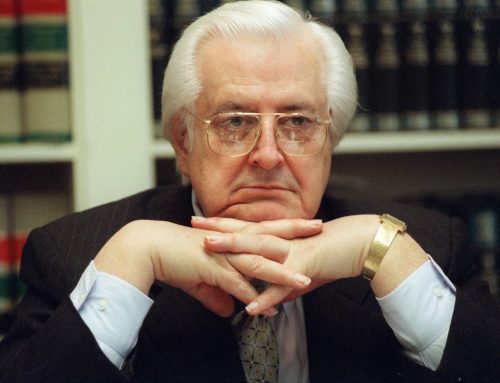
On Saturday, January 1, 1985, Henry Morgentaler placed an advertisement in The Montreal Gazette. “I need your help,” says the text nest to a photo of Morgentaler.
“I am fighting for women’s rights to safe medical abortions against almost insurmountable odds: the governments with their unlimited power and money and a vocal, fanatical, right-wing group of anti-abortionists who use intimidation, slander and threats of violence against me. I do not personally have the financial resources—. Won’t you help me?
“I am determined to fight in spite of constant harassment and the danger involved. With your help we can and will win. We must not allow a small, fanatical minority to deny reproductive freedom of Canadians. I need your support.”
Morgentaler said the ad was a trial balloon. Ads will be placed in other newspapers if this one pays off.
Sold five buildings?
Judy Rebick, spokesman for the Ontario Coalition for Abortion Clinics said the target for fundraising was $150,000. She explained that the same amount had been raised in the past but that $50,000 is still owed to Toronto lawyers while $20,000 is still outstanding for legal fees in Winnipeg. Four days later in a telephone interview on January 9, Morgentaler noted that the response to the ad had been “terrific.” About 250 letters with donations totaling over $7,000 had been received, he said. (On January 15, Judy Rebick stated that the total had neared $15,000.)
In the same Canadian Press interview as above, Morgentaler observed that he could have been a millionaire from his abortion practice if it hadn’t been for the legal battles. He claimed that the debt was still $150,000 (compare statement above). He said that he had sold five buildings he owned in Montreal to help defray legal costs and that he lost “probably $250,000 or $300,000” on the Winnipeg and Toronto clinics.
“Allowed” people to contribute
Readers may recall Interim’s calculations of Morgentaler’s income on the front page of the January issue. Based on evidence provided at the Toronto trial in October 1984, and assuming normal operations for the abortion clinic, his income from Toronto alone through “consulting “ fees ($50 per abortion) and corporate income — but without dong the abortions himself — would be close to three quarters of a million dollars. While the Toronto abortuary has not been operating normally at all (in fact it had been closed for a year and a half before abortions were resumed in December 1984), the Montreal abortion clinic did operate at full capacity. Moreover, here Morgentaler does the abortions himself ($75 out of $300 per abortion). If it is assumed that Morgentaler may well receive a “consulting” fee for every abortion done by the 28-30 doctors he claimed to have “trained” in “his” method, his annual income would be somewhere between one and two million dollars. (Quebec abortions number approximately 15,500 a year, most of which are probably done in hospitals by doctors independent of the Morgentaler chain.) As Morgentaler put it in the CP interview: “I am not going broke. The idea is I don’t want to go broke.”
From the above it is clear that Morgentaler’s “I-need-your-support” strategy is not one based on personal financial need. Legal costs are kept separate in order to justify public financial drives which, in turn, firm up individual commitments and garner widespread publicity. As he told the Gazette (Jan. 10): “the ad is a good way to get in touch with the women across Canada. We haven’t mobilized public support in the past and allowed people to be able to contribute.”
AH