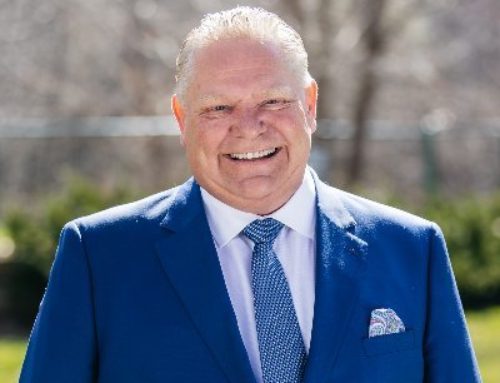
Campaign Life Coalition interviewed Tom Wappel, former Liberal MP and current political advisor to CLC, Oct. 10.

Tom Wappel receives the prestigious Joseph P. Borowski Award from Campaign Life Coalition’s Karen Murawsky in 1998 for his dedication to the unborn in the public arena.
Campaign Life Coalition: In a democracy, the way we make our voices heard is by electing people who represent our views to the House of Commons and to Provincial Legislatures. There are many steps to this. Help our readers understand the process. Let’s start with joining a riding association of the party of your choice.
Tom Wappel: That is the biggest and most crucial step to take and the most difficult for most people. If you don’t do that, you don’t take part in the political process, and if you don’t take part in the political process, it means that you’ve left your future in the hands of those who do take part. Only a tiny fraction of the Canadian population is actively involved in the political process, and I don’t mean going to vote once every four years, I mean the political process from the ground up. That’s where candidates are chosen, that’s where policies are made, that’s where polices are voted on, that’s where policies are vetted, where candidates are vetted, and if you are part of the process of choosing the candidate, then you, as a very small number of people, have made a decision for approx. 125,000 other people. So your best leverage for power is at the riding level where you can make a difference, and the reason that is so powerful a position is because so few people do it.
CLC: How do we identify possible pro-life candidates?
TW: Well that’s a very good question, because the question then becomes how do you define pro-life. If we take the position that I would take, that you support life from conception to natural death, and that you oppose abortion in all circumstances then you have to be vocal about that. You can’t say “well that’s what I believe, but I can’t say it because I won’t get elected.” You have to find someone who is prepared to openly state what they believe privately. They don’t have to beat the drum so that it is the only thing they talk about, but as part of an overall broad policy perspective on the issues that concern Canadians and Canada. One of them has to be, and it has to be in the forefront, the protection of life. You‘ve got to find someone like that. If the person cannot communicate their views understandably; they are not likely going to win. So you are looking for someone who is a communicator and who is able to express their views in an understandable and persuasive manner.
CLC: How do we help them win nominations?

In 1990 Tom Wappel ran for the Liberal leadership and won a majority of delegates from Saskatchewan at the party convention in Calgary because of the support of pro-lifers.
TW: The candidate you choose should be encouraged to try to bring as many people into their tent as possible so that there is a broad coalition. I would not have been able to win without the support of Campaign Life Coalition and pro-lifers, but I would not have been able to win with only the support of Campaign Life Coalition and pro-lifers. I was able to build a coalition of people, many of whom did not agree with my position on abortion but agreed that I would be an excellent candidate. The candidate is critical in this process. Generally speaking, the person who is seeking to be the candidate in that riding, who brings out the most people physically to vote at the candidate nomination meeting, wins and becomes the candidate of that party. It doesn’t matter how many people signed up, what matters more is how many people show up. I had perhaps 700 people signed up and my opponent had about 1100 people signed up, but when it came to the actual meeting, 75 per cent of my people showed up to the meeting, compared to his 35 per cent, so I won by a healthy margin. That’s Toronto. If you’re talking about some riding in northern Quebec, you may have only 50 people show up at the nomination meeting, maximum.
CLC: How do we help them get elected?
TW: You need volunteers and you need money. You have to buy signs, you have to prepare literature, you have to have buttons, you have to have a telephone bank to call voters etc. If you want your candidate elected, you have to support that candidate financially, and you have to support them with volunteerism. Somebody has to put up those signs, somebody has to deliver the brochures, somebody has to get on the phone and call all the voters and somebody has to go with the candidate and knock on the doors. Volunteerism and monetary contribution are absolutely critical. Once your candidate has won the general election, that candidate, in the current political climate, is going to be isolated. So it doesn’t end when the candidate is elected. You might even say that it begins when the candidate is elected. And if you abandon the newly elected MP at that point, it’s a very lonely place and it takes a lot of strength to remain true to your principles if everybody else has gone on with their lives and you’re by yourself up there in Ottawa. It’s absolutely critical that people remain involved, providing prayers and encouragement throughout, including writing letters of support encouraging that member of parliament to remain vocally pro-life.
CLC: Working to elect a pro-life leader – can you share your personal experience with your leadership bid in 1990?
TW: You can’t get a pro-life leader of any party unless the majority of delegates voting for that leader at a leadership convention are pro-life. It’s that simple. Each riding in the country has a certain number of delegates, all of them equal. Unless a majority of those delegates voting are pro-life and vote pro-life, you will not get a leader who is pro-life.
When I ran for the Liberal party leadership in 1990, and I was trying to convince delegates to support me, I was told on many occasions “well I’m supporting Jean Chrétien, he’s pro-life, he’s Catholic, he’s one of 13 children, and he’ll be ok.” Very difficult to argue with people who have convinced themselves in the face of evidence to the contrary that this is what is going to happen. There were also people who told me that they were elected as Chrétien delegates, but voted for me. When I ran, that was the first time that someone ran for leadership of the Liberal party and was openly and proudly pro-life and didn’t back down from it.
CLC: It is interesting how it all comes back to joining the riding association, because if you join a riding association you can become a delegate for that association.
TW: And if you don’t become a delegate, you vote for delegates. For example, I had a very strong team that worked for me in the province of Saskatchewan in 1989-90 and they organized a tremendous number of pro-life people throughout the province. Federally, the Liberal party is not that strong in Saskatchewan, but every riding has a Liberal riding association. So, there are ridings that haven’t seen a Liberal elected in 100 years but there is still a Liberal riding association and there might be 12-15 members in total of which eight is a majority to elect a slate of delegates. My team worked very hard to join different riding associations and then to elect delegates in those riding associations. Saskatchewan was the only province in the country where Mr. Chrétien did not win the majority of delegates. I won the majority of delegates.
CLC: And it was all thanks to that real pro-life grassroots effort?
TW: Absolutely, so for those who say it can’t work, I simply point to Saskatchewan, and what happened in Saskatchewan in 1990 could’ve happened in British Columbia, could’ve happened in Quebec.
CLC: Putting forward pro-life bills and motions when you’re in a pro-life minority situation isn’t easy. How can we work at the riding level to encourage MPs to introduce legislation?

Tom Wappel addresses the National March for Life in Ottawa.
TW: Any MP can put forward any bill or motion they want. If they put forward a bill or motion that their party leadership is not happy with, there are going to be consequences. So you have to decide as a MP if you are prepared to accept the consequences. When I was Member of Parliament under the prime ministership of Jean Chrétien and Paul Martin, or leadership of Stéphane Dion, and John Turner, when I started, nobody told me I couldn’t present any particular bill, and I presented many pro-life bills. If I was punished, I didn’t notice it.
At the riding level, you’ve got to support your member of parliament and this is where social networking comes in. If a MP puts forward a private members bill that is pro-life, you can contact your friends, neighbors, relatives across the country and encourage them write to their member of parliament asking them to support it.
CLC: How do we get solid pro-lifers into the Senate and into the Supreme Court as judges?
TW: You can’t be worried about game 7 of the Stanley Cup finals when you’re in October. You have to take every game, every period, one period at a time, every win eventually builds up and eventually you reach your goal. So, you elect one pro-life MP, you elect another one, you elect pro-life members from different parties, eventually you will get to the stage where you will have a majority of pro-life MPs in a party. At that point, it’s quite likely that you will elect a pro-life leader who will at some point become the Prime Minister. That Prime Minister has to look at judges who are going to interpret the law, as opposed to make the law. It’s parliament that makes the law and judges that interpret it, not the other way around. And we’ve had a lot of activist judges on a number of courts using the Charter to make laws that parliament either refused to make or specifically rejected. It’s a long process.
CLC: When you resigned your seat, your successor was parachuted in by the party. What happened there?
TW: My riding wanted a fair, open, democratic and clean nomination battle where anyone who wanted to, could run and may the best man or woman win. I supported that position. I met with Stéphane Dion and I asked him to make sure that there would be a fair and open democratic nomination, that anybody who wanted to, who met the criteria of the party could run. In the face of that, he appointed this particular woman who was the president of another Liberal MP’s riding association as the candidate. What was sad about this was that, notwithstanding that she was not pro-life, many of the people who had supported me because of my pro-life stance, suddenly forgot that they were pro-life and remembered that they were Liberal and ended up supporting this person. I’ve always said, it’s got to be the person first, and the party second. Not the other way around.
CLC: They say it’s easier to turn a pro-lifer into a politician than a politician into a pro-lifer. What would you say to someone who has strong pro-life convictions and is considering a run for office?
TW: Do so, most people fail because they believe they are going to fail. If you put your name forward, the worst that could happen is that you don’t win. Perhaps the worst thing that could happen is you do win, literally speaking. If I had feared failure, I would never have run for the leadership, if I had feared failure I would never have sought the nomination. I had my share of losses, I mean when I joined the party, in my riding I ran for membership secretary, and I lost. If that had been it for me and I said ‘ok well I lost, and nobody likes me, I’m out of here,’ my entire life would’ve been entirely on a different path. I ran again for membership secretary the next year, I won. So, if somebody is pro-life and cares about their country and wants to, feels that they have the strength and ability to try to be involved in the cut and thrust and the gladiatorial combat, of being a member of parliament, then go ahead and try. That’s all you can do, you might be successful, you might not be successful, but you will never know unless you try.