Paul Tuns, Review:
Against the Machine: On the Unmaking of Humanity
by Paul Kingsnorth (Thesis, $42, 348 pages)
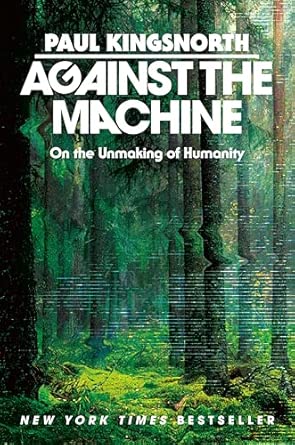 Paul Kingsnorth, a former Wiccan-practicing environmentalist who became a rural-living conservative has written an important book looking askance at what most people would consider progress. Against the Machine is a critique of techno-optimism, an expose of the soul-destroying aspects of technology and modern sensibilities.
Kingsnorth, a former anti-capitalist activist, is plenty skeptical of private enterprise, but ultimately, he is not making an economic argument, even though he criticizes the Machine’s swallowing of cultures, devastation of the environment, and breaking of boundaries. He is making a cultural argument: “The Machine is not simply a vast, soulless mechanism for accruing wealth,” but a “sacral object in itself.” Sometimes the Machine’s mythology is called “progress” or “growth” but is actually a “deity.”
Kingsnorth describes more than defines the Machine – always capitalized — which “manifests today as an intersection of money power, state power and increasingly coercive and manipulative technologies which constitute an ongoing war against roots and against limits.” He explains, “Its momentum is always forward, and it will not stop until it has conquered and transformed the world,” with “Its endgame … the replacement of nature with technology, in order to facilitate total human control over a totally human world.” The Machine is not so much a technology or other physical manifestation, as much as an ideology or mindset.
The Machine creates an “anticulture” replacing the Four Ps of humanity, Past, People, Place, and Prayer, with the Four Ss of Science, Self, Sex, and the Screen. Kingsnorth says that “central to the emerging religion of the Machine will be (the) deifying of the self.” Modern man, he argues, has become like both Narcissus and Lucifer, “entranced by his own beauty and power.” He explains, “if the self is the object of our worship and science our new priesthood, then we could say that sex is our liturgy and prayer rule,” with Kingsnorth arguing “the sexual revolution of the 1960s is beginning to look like one of the most consequential aspect of the modern revolution” in which society “maniacally centres it in all its forms” as “sexual expression and identity as the core of our human being.”
Screens enlarge the scope of all problems afflicting mankind, so the “technologization of sex and sexuality” is manifested by maladies such as by a critical amount of online hookups, IVF, and gender confusion that is widespread enough to “shift our relationship with human nature, and with nature in general.” At times, Kingsnorth makes broad assertions without providing the necessary evidence; he assumes the problems are there for all who have eyes to see and ears to hear, but if the Machine’s ubiquity and power are as Kingsnorth’s critique suggests, then the blind and deaf are legion.
The world of the Machine, disconnected from the Four Ps, is a world devoid of meaning and roots. “We find ourselves rootless, rudderless, unmoored in a great sea of chaos; angry, confused, shouting at the world and each other.” This is the Great Unsettling. (There is lots of Germanic-style capitalization in Kingsnorth’s book.) Unmoored from hearty loves, endurable hierarchies, strong rules, and the like, “the Age of Aquarius slides into the age of transhumanism as we seek, openly now, to become the gods we always wanted to be.” Human beings illusorily believe that technology will give them control, when in fact, it is controlling humanity.
Kingsnorth says the solution to resisting the Machine is a restoration of religious life. We need a rediscovery of enchantment and awe to restore a sense of humility. This is a big ask. So is the injunction “we simply have to walk away from the Machine in our hearts and minds,” if the Machine is as powerful as Kingsnorth claims. More reasonably, he urges the enjoyment to “inhabit again,” the tangible joys such as writing, walking, and loving others. If the goal of the Machine is the illusory understanding of happiness as instant gratification, desires met by the machine — “(we) have every gadget and website and storefront and exotic holiday in the world available to us” – we must reorder our wants.
Kingsnorth has written a critique of potentially dehumanizing technology, that sometimes is a little too Luddite, steeped in too much nostalgia, lacks specific examples, and is occasionally meandering, but which still provides some much-needed skepticism about the promises and impacts of the worldview driving the Machine.