Kesiah Beere
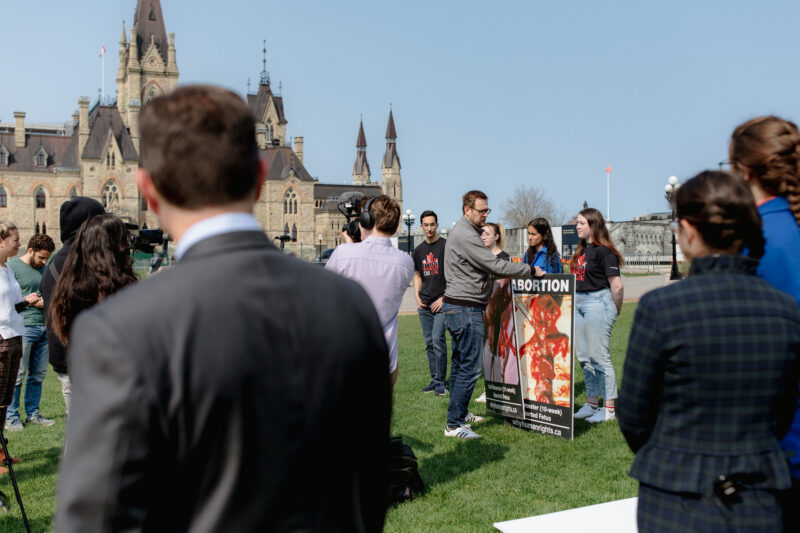 On June 11, the Ontario Superior Court of Justice ruled in favour of applicants Campaign Life Coalition (CLC) and Maeve Gainey in a lawsuit against the Parliamentary Protective Services (PPS). Justice Calum MacLeod held that PPS’s order requiring CLC and Gainey, then Maeve Roche, to remove images depicting abortion victims from Parliament Hill violated their section 2(b) right to freedom of expression under the Canadian Charter of Rights and Freedoms.
According to a CLC news release, the lawsuit arose as a result of the events preceding a CLC press conference on Parliament Hill.
On May 10, 2023, the day before the National March for Life, CLC intended to display signs depicting abortion victims during their press conference. Before the event began, one PPS officer examined the images and deemed them to be “too graphic” to exhibit on the site, supposedly in violation of the property’s rules.
Activities on Parliament Hill are subject to the General Rules for the Use of Parliament Hill (Rules), which ban the display of “obscene messages” and “messages that promote hatred or violence.” In a revised version of the Rules that went into effect on the same day as the confrontation, “signs or banners that display explicit graphic violence or blood” are also prohibited.
CLC and Gainey contested the restrictions as an infringement of their Charter right to freedom of expression under section 2(b).
Gainey, who was CLC Youth coordinator in 2023, told The Interim that Parliament Hill is “the symbolic heart of our democracy. For generations, Canadians have gathered there to petition lawmakers, protest government policies, and express deeply held beliefs.” She explained that the challenge was significant because it “raises important questions about how freedom of expression is protected in public spaces dedicated to democratic participation.”
In March of 2026, Justice MacLeod issued an opinion on the matter. He explained that although technically in effect, these new Rules were not yet published at the time of the press conference. For this reason, Justice MacLeod considered whether display of abortion victim photography on Parliament Hill violated the earlier version of the Rules, which only barred obscene messages and those promoting hatred and violence
Justice MacLeod recognized that the signs did not meet the definition of “obscenity” delineated in the Criminal Code. Rather, the PPS officer judged the images to be obscene in accordance with its meaning as “strongly repulsive to the sense of decency and propriety.” However, the Court found this classification “both vague and arbitrary.”
It was further argued by PPS that the signs promoted hatred or violence on the basis that QR codes on the signs led to a website that referred to abortion as “murder” and those complicit in it as “murderers.” Nevertheless, Justice MacLeod regarded it “a leap to categorize the images as promoting hate or violence.”
“The signs were described by one of the constables as ‘abhorrent,’ Justice MacLeod wrote in his decision. “That is undoubtedly true and is precisely the objective of communication designed to persuade members of the public that abortion itself is an abhorrent practice.”
Since displaying abortion victim photography did not violate the Rules, banning the Applicants’ signs on Parliament Hill breached their Charter right to freedom of expression. Justice MacLeod held that the section 1 reasonable limits clause did not justify the infringement.
Though the ruling did find that the Applicants’ freedoms had been breached, the Court did not make a judgment on the validity of the Rules themselves.
In a news release, the Justice Centre for Constitutional Freedoms (JCCF) quoted the reaction of Hatim Kheir, CLC’s lawyer on the case, saying: “Parliament Hill has long been a place where Canadians gather to communicate political messages directly to lawmakers and to the public. We are pleased that the Court recognized that constitutional freedoms cannot be restricted through subjective and unpredictable censorship.”
Celebrating the victory, Gainey told The Interim that she was “grateful for the decision and encouraged by the court’s recognition that our Charter rights were infringed. Freedom of expression protects speech and advocacy that others may find uncomfortable or controversial. If constitutional protections only applied to popular viewpoints, they would have little meaning.”