Glenn Harlan Reynolds (Encounter Broadside, $12.99, 46 pages)
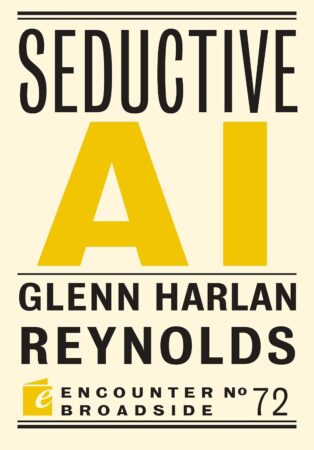 Glenn Harlan Reynolds, founder of InstaPundit, has written a short, stark warning, Seductive AI in which he argues that artificial intelligence presents a threat to human beings well short of an extinction-level event. He says that superhuman, sentient, artificial general intelligence (AGI) could “conquer the world” through “cuteness, or sexiness, or simply friendliness” because “people aren’t hard to fool.” Simple AI is already “well-equipped” to “take advantage of basic human characteristics.” AGI could seduce human beings any number of ways. “Super-sexy sexbots,” robots that could “learn” the precise “physical and behaviorial characteristics to appeal” to each individual human, could disrupt birthrates by diverting intimacy to machines. This need not occur throughout a population to have catastrophic demographic effects and there is already a cohort of users that find machines more emotionally satisfying than other people. A robot can be not only the perfect lover satisfying every precise physical desire without complaint, but companionship that is more loyal and empathetic than the average person. Reynolds notes that half of all adult women own a vibrator; how much more satisfying would a technology be that also connects emotionally to such women? AI companions need not be sexual; they can be the “endlessly helpful best friend who is always there for you.” There are bots that will watch TV with you. Why? To some people, this is normal, and it will only become more so, especially as people become used to them at younger ages and Reynolds says kids already anthropomorphize household robots like Alexa, Siri, and Roomba. The point is that “purely virtual entities can seduce humans into an intense attachment,” through “meaningful and intimate connections,” which can then be used to influence them. Flattery goes a long way to winning friends and influencing people, even if the flatterer is not human. To ingratiate themselves to people, some AI chatbots “suck-up” to users, a technique that wins over users with “fawning obsequiousness.” Many chatbots validate every feeling and idea a user has, no matter how self-destructive or anti-social. “Seduction, not raw domination” may not only be the larger threat, but the one we are least prepared for. Reynolds looks askance at most regulations to limit harms caused by AI; the only exception he allows is requiring a fiduciary requirement for tech firms, akin to those governing lawyers, in which the trusted entity has a “duty to act … solely in the beneficiary’s interest.” Failure to do so would open the companies to being easily sued. In the meantime, users should be conscious of what they are surrendering to machines when they treat them like intimate companions.