Paul Tuns, Review:
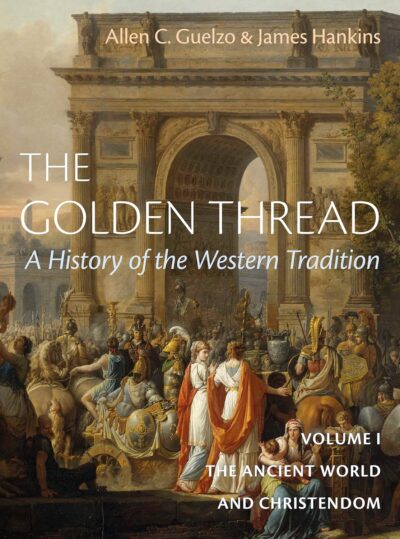
 The Golden Thread: A History of the Western Tradition: Volume 1 The Ancient World and Christendom by Allen C. Guelzo and James Hankins (Golden Thread Academic, $155.99, 1258 pages)
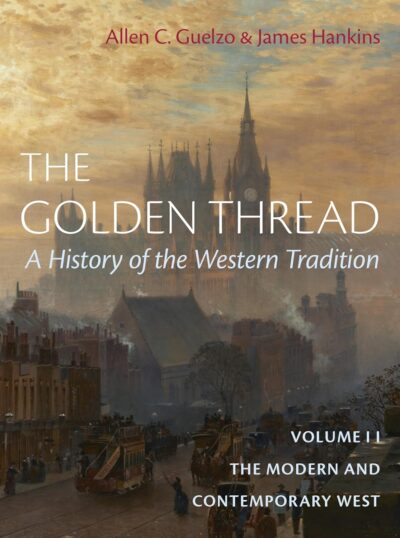
The Golden Thread: A History of the Western Tradition: Volume 2 The Modern and Contemporary West by Allen C. Guelzo and James Hankins (Golden Thread Academic, $155.99, 874 pages)
Among the culture wars, perhaps one of the least appreciated is the battle over the teaching of history. As we note in our editorial this month, Canadian history is not taught as an apology for the supposed twin crimes of colonialism and racism and the violence Europeans have allegedly inflicted upon indigenous populations merely for having met them. The entirety of Western history is generally apologized for by academics today rather than seen as a civilization worth celebrating. Into this mix enter historians Allen C. Guelzo and James Hankins with their two volume The Golden Thread, a celebration of the greatness of our civilizational inheritance.
The title comes from the spool of thread given to Theseus by Princess Adriadne in Greek lore so he could find his way back through Daedalus’ labyrinth and slay the minotaur. That thread is delicate. As Guelzo and Hankins write, “We want our readers to understand just how fragile our tradition is and how many times in the three-thousand-year-long history of the West the golden thread that ties us to our past and enriches us beyond measure has come close to snapping.” The threads that have weaved Western culture, the authors explain, are the “key dimensions of Western literature, philosophy, architecture, music, and spiritual insight.” While events are reported, the key developments that Guelzo and Hankins follow are intellectual, for the greatness of the Western project is not the sum of its military victories and stretches of empire but the life of the mind, the best that “Jerusalem and Athens” have provided the Western tradition.
In volume 1, The Golden Thread covers Greco-Roman and Jewish antiquity and runs through European Renaissance. In volume 2, it begins with the Protestant Reformation and ends with the World Trade Centre bombing of 1993, closing, hauntingly, with a photograph of the World Trade Centre in New York City.
One important thread that the authors cover is the law, beginning with Roman (“The Twelve Tables”) and Athenian law (stripping power from the Areapagus), and the relationship between institutional power and protection and elites and the people. The thread continues with examinations of the role of customary law and the Julian laws, which privileged marriage and child-bearing, and punished the lack of, importantly, reinforcing private morality by, for example, turning adultery, “hitherto punished by the family” into a “public crime and subject to persecution.” The authors explore the role of religion, the Mosaic covenant and the Ten Commandments, and Justinian’s commission of the Corpus iuris civilis (“The Body of Civil Law”) through the Scholastic building of systems, and finally the Magna Carta and development of English Common Law. In doing so, Guelzo and Hankins illustrate that the Greeks, Romans, and early Christians, “lay the foundations for a European civilization that has been, from the eleventh century onward, an amalgam of all the previous ones.”
These two volumes are a remarkable achievement in scholarship but what elevates them is that they are presented in ways that make history intelligible. They would make an excellent pairing for the teaching of European and American history although outside of homeschoolers it is difficult to imagine institutional schools, captured by vandals of the Western tradition, utilizing them to teach students. That is a mark against modern education, not these books. Both volumes have copious beautiful illustrations and maps, summary timelines, excerpts of original sources, and biographies of key figures. To take just the example of the section on the French Revolution in 1789, which set the stage for bloody revolutions of the 20th century, there are images of Louis XVI, the signing of the preliminary peace negotiations between Great Britain and the United States, the opening of the Estates-General at Versailles, the Oath of the Tennis Court, the capture of the Bastille, the pillaging of a church, a speech in the new legislative assembly, the trial of Louis XVI, the famous painting The Death of Marat, various executions, including that of Napoleon Bonaparte (among many others), a map of Paris, a map of the various conflict locations in France, a three page summary of Edmund Burke’s views on the American and French revolutions, and a one-page biography of the revolutionary leader Robespierre.
Yet none of these illustrations and sidebars distracts from the story that the authors tell, which, again, in the case of the French Revolution, begins with the antecedents of the Revolution to the “experiment in perfection” to the “revolution eats its own” through to Napoleon’s rise, which along the way required three new constitutions to be written.
The Golden Thread will reward reading for anyone interested in history, whether learning about it without the ideology that current historians and teachers approach the topic, or as a refresher for those taught in less guilt-ridden times. For as much sense as these two volumes make for the education of young minds as a text book, we would all do well to remember the intellectual heritage and historical events that have created the modern West.
[/fusion_text][/fusion_builder_column][/fusion_builder_row][/fusion_builder_container]