Russell Kirk on America: How to Understand the Legacy of 1776:
Edited by Michael Lucchese
(Creed and Culture, $36.99, 210 pages)
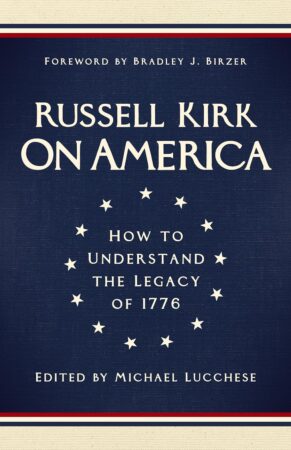 The new publishing house Creed and Culture has helped mark the 250th anniversary of the Declaration of Independence by collecting excerpts from the works of American conservative essayist Russell Kirk. The collection, edited by Michael Lucchese, with a foreword by Bradley J. Birzer, provides Kirk’s insights into the Declaration, the U.S. Constitution, and the country’s founding, as well as portraits of American statesmen and authors. The conservative thread that runs throughout can be summarized by Kirk’s comment on Orestes Brownson, an under-appreciated 19th century American thinker: “the character of true social justice,” Brownson tells us, is “liberation of every person, under God, to do the best that is in him.” The world, Kirk argues, “is a place of trial and struggle, so that we may find our higher nature in response to challenges.” America was ideally situated to allow human flourishing by overcoming trial and struggle because as Kirk illustrates, it was the culmination of the best of western civilization, combining, in the words of Birzner in his foreword, the best of Jerusalem (the Judeo-Christian tradition), Athens (Greece), Rome (ancient Rome), and London (commercial culture and the sober-minded Enlightenment thinking). The founding of the United States was not a revolutionary break with the European tradition but a continuity. Unlike many celebrants of the American project, however, Kirk does not focus on rights, although he was clearly a believer in natural rights. Instead, Kirk focused on duties and obedience to natural law. The proper perspective of freedom, justice, and order requires an understanding on not only mankind’s claims to various liberties, but his obligations. To Kirk, the needs of the individual were to be balanced with the needs of the community, and America at her best does this through robust local institutions such as families, parishes, and towns. It is a great irony that the consolidation of a great nation spanning a continent was able to do so, but as Kirk observed in The Conservative Mind (and excerpted in this volume), “federalism has had a great share in keeping the United States the most conservative power remaining in the world.”