Review: Making Sense of Suffering,
by Peter Kreeft (Ignatius Press, $17.95 USD, 215 pages)
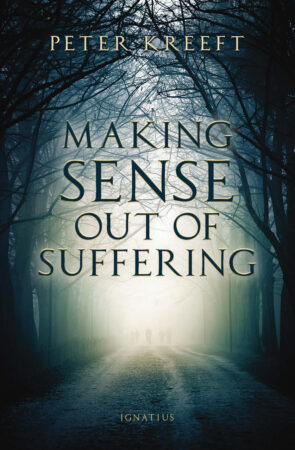 Ignatius Press has re-released Peter Kreeft’s 1986 book Making Sense of Suffering and although the causes of our suffering might have changed, mankind’s reaction to suffering has not. It was, and remains, one of the main arguments against God: how could an all-powerful, all-good being allow innocent people to suffer? Kreeft turns suffering as an objection to the existence of God on its head and persuasively argues that without God, suffering makes very little sense.
Most people understand that wrongdoers can suffer, but most people have trouble comprehending the newborn with a painful fatal disease or the good person suddenly struck by tragedy. The innocent suffering unduly seems to make little sense; it is unjust according to human principles. Kreeft says that is the wrong prism through which to look at suffering, which must be judged by divine justice, not the human kind.
First, Kreeft must define suffering, which he begins by noting the definition used by Buddha (Gotama Siddhartha), namely the gap between desire and reality. Buddha taught that human beings reduce suffering by ending their desires. Kreeft calls that “spiritual euthanasia,” killing the patient (the self) rather than the disease (egotism and selfishness) because Buddha “seems never to be simply aware of the possibility of unselfish love, unselfish will, unselfish passion, an unselfish self.” None of those are simple to achieve, but through Jesus Christ’s “radical program” mankind can transform human nature to one that aligns with God’s wish for humanity: to be united with Him in heaven. Without this transformation, individuals are prone to “a general grayness that settles like dust over our lives.”
Modern man – that is secular man – cannot fathom Christ’s radical program and thus “our society is the first one that simply does not give us any answer to the problem of suffering except a thousand means of avoiding it” – although it can’t really do that, either. The modern mind has trouble comprehending mysteries. Suffering is a mystery, not merely a problem. Problems are solved by answers, but God has only given us clues.
Kreeft says there are three kinds of evil: suffering (disharmony between our embodied selves and the physical world), death (disharmony between the soul and the body), and sin (disharmony between our souls and God). The three are interconnected, but Kreeft rightly argues that “the gut-level problem of evil moves us to rebellion rather than philosophy.”
Mankind, a rational creature capable of wonder, instead lashes out against the reality of suffering through ten “easy answers”: atheism (no God), demythologism (fairytale God), psychologism (subjective God), polytheistic or paganism (many Gods), scientistic or new paganism (naturalistic God), dualism (two Gods), Satanism (God is bad), pantheism (Blob God), deism (snob God), and the denial of evil (idealism). Kreeft rebuts each one, and one that answers several objections is that “there has been plenty of time for evolution to have finished” so “there should be no evil left.” Kreeft says “evil, imperfection, and suffering in the universe proves the atheist wrong about the universe.” Furthermore, if God does not exist and there is not “infinite goodness,” Kreeft asks, “where do we get the idea of evil?” because a lesser thing cannot create a greater thing.
Kreeft says to the modern mind, “the idea of any unsolvable question is scandalous and unacceptable.” Thus, many people rebel against God and goodness. But this prioritizes “my will be done” not “Thy will be done.”
The alternative to these unsatisfactory answers is that “beyond death and beyond suffering there is life and joy” because “we are bits of darkness surrounding by great light, not bits of artificial light surround by cosmic darkness.” God must be all-powerful; if not, why trust Him? God must be all-good; if not, why love Him? We must look beyond the misleading appearances and trite human explanations: we must look for clues.
The question – the problem – of suffering is whether “it” is worthwhile, but to know that people must know the end of the story. People of faith have one answer for that, but ultimately that is unknowable. But it is a clue. People of no or weak faith have a different, unsatisfying answer for whether suffering is worthwhile: no, it is not because life on earth is all there is.
God, Kreeft suggests, trades “our subjective happiness for our objective happiness.” Or as Paul says in Romans 8:28, “in everything God works for good with those who love him.” Or as Kreeft puts it, “a good God wouldn’t do anything for no reason” so “I believe all suffering is at least potential good, an opportunity for good.” That is the only explanation that makes sense.
To understand why human beings suffer, we must admit that “our only qualification for God’s grace is our emptiness, not our fullness; our undeservingness, not our deservingness.” By both Original Sin and our own sins, each person is unworthy of Heaven and we need pain and death to teach us the humility to approach God knowing we are empty and undeserving. Suffering makes us wise – if we let it. Suffering trains us to see God in better light – if we allow it. Unfortunately, because of mankind’s fallen nature, “pain embitters as often as it mellows.”
Kreeft explores various themes using philosophers and artists, each giving further clues to approach a more satisfying understanding of the mystery of suffering. Kreeft concludes “perhaps the reason why we are sharing in a suffering we do not understand is because we are objects of a love we do not understand.” In addition to our emptiness and undeservingness, there is our smallness compared to the enormity of God’s love, wisdom, and justice. Eternal joy means infinitely more than the “relief of sorrow;” it means knowing the fullness of God’s love. If Christians truly understood that, we would happily carry our crosses rather than bemoaning the suffering that its slivers cause us to endure. And further evidence of God’s goodness is that he can, in fact, as Augustine argued, “allow evil to exist and out of it produce good.”